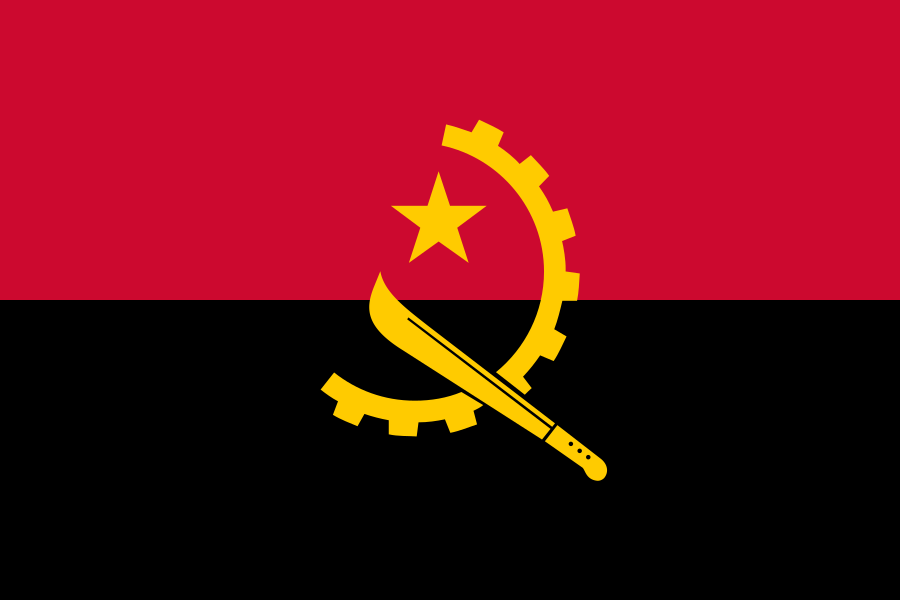
Angola, formally the Republic of Angola, is a nation on Southern Africa's west coast. It is the second-largest Lusophone (Portuguese-speaking) nation in terms of total territory and population (after Brazil), and the seventh-largest in Africa. It is bounded to the south by Namibia, to the north by the Democratic Republic of the Congo, to the east by Zambia, and to the west by the Atlantic Ocean. Cabinda, an exclave province of Angola, borders the Republic of the Congo and the Democratic Republic of the Congo. Luanda is the capital and most populous city.
Angola has been inhabited since the Paleolithic period. Its emergence as a nation-state stems from Portuguese colonialism, which started in the 16th century with coastal colonies and commercial ports. European settlers eventually started to establish themselves in the interior throughout the nineteenth century. Due to opposition from local tribes like as the Cuamato, Kwanyama, and Mbunda, the Portuguese colony that became Angola did not have its current boundaries until the early twentieth century.
Angola gained independence in 1975 as a Marxist–Leninist one-party republic after a lengthy anti-colonial struggle. The same year, the country descended into a devastating civil war between the ruling People's Movement for the Liberation of Angola (MPLA), backed by the Soviet Union and Cuba, and the insurgent anti-communist National Union for the Total Independence of Angola (UNITA), backed by the US and South Africa, and the militant National Liberation Front of Angola (FNLA), backed by the Democratic Republic of the Congo. Since attaining independence in 1975, the nation has been controlled by the MPLA. Angola emerged as a reasonably stable unitary, presidential constitutional republic after the conclusion of the conflict in 2002.
Angola has vast mineral and petroleum reserves, and its economy is among the fastest-growing in the world, particularly since the end of the civil war; however, economic growth is highly uneven, with the majority of the country's wealth concentrated in a disproportionately small sector of the population and heavily concentrated in China and the United States. Most Angolans continue to live in poverty; life expectancy is among the lowest in the world, and infant mortality is among the greatest. Since 2017, the administration of Joo Lourenço has made tackling corruption a priority, so much so that several former government officials are either imprisoned or awaiting prosecution. While foreign ambassadors have recognized this endeavor as legal, other critics believe the efforts are politically motivated.
Angola is a member of the United Nations, the Organization of Petroleum Exporting Countries, the African Union, the Community of Portuguese Language Countries, and the Southern African Development Community. Angola's population is expected to reach 32.87 million by 2021. Angola is a multiethnic and cosmopolitan country. Angolan culture shows centuries of Portuguese influence, including the dominance of the Portuguese language and the Catholic Church, interwoven with a wide range of indigenous customs and traditions.