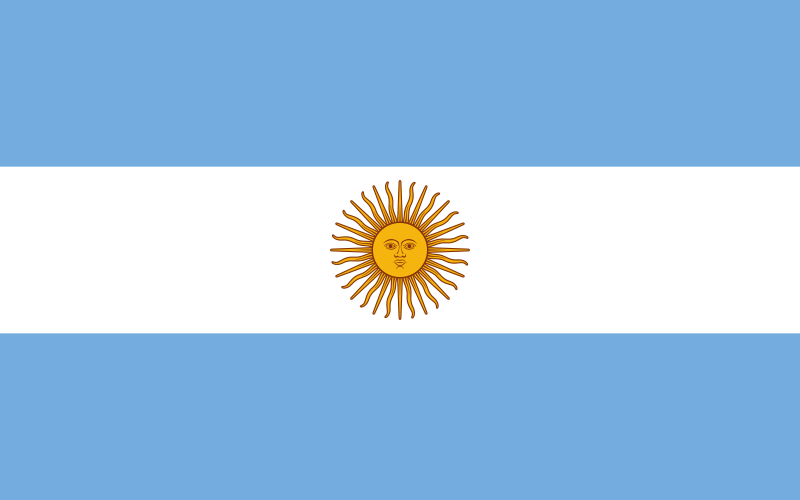
Argentina, formally the Argentine Republic, is a nation in South America's southern half. Argentina is the world's biggest Spanish-speaking country by size, with a land area of 2,780,400 square kilometers (1,073,500 square miles). It is South America's second-largest nation after Brazil, the Americas' fourth-largest country, and the world's eighth-largest country. It shares the majority of the Southern Cone with Chile to the west and is additionally bounded to the north by Bolivia and Paraguay, to the northeast by Brazil, to the east by Uruguay and the South Atlantic Ocean, and to the south by the Drake Passage. Argentina is a federal-state split into twenty-three provinces and one autonomous city, Buenos Aires, which serves as the federal capital and biggest metropolis in the country. The provinces and the capital each have their own constitutions, yet they are all part of a federal government. Argentina claims sovereignty over a portion of Antarctica, as well as the Falkland Islands and South Georgia, and the South Sandwich Islands.
The Paleolithic epoch is the oldest documented human presence in modern-day Argentina. In pre-Columbian times, the Inca Empire spread to the northwest of the nation. The country's origins may be traced back to the 16th-century Spanish colonization of the area. Argentina came to prominence as the successor state of the Viceroyalty of the Rio de la Plata, a Spanish foreign viceroyalty established in 1776. The proclamation of independence and the subsequent battle for independence (1810–1818) were followed by a prolonged civil war that lasted until 1861, resulting in the country's reformation as a federation. Following that, the country enjoyed relative peace and stability, with several waves of European immigration, primarily Italians and Spaniards, radically reshaping its cultural and demographic outlook; today, more than 60% of the population has full or partial Italian ancestry, and Argentine culture has strong ties to Italian culture.
Argentina became the seventh-wealthiest country in the world by the early twentieth century, thanks to an almost unprecedented surge in income. Argentina's GDP per capita exceeded that of the United States in 1896 and remained in the top 10 until at least 1920. It is now rated 71st in the world. Argentina plunged into political instability and economic deterioration after the Great Depression of the 1930s, pushing it back into underdevelopment, although being among the fifteen wealthiest nations for many decades. After President Juan Perón died in 1974, his wife and vice president, Isabel Perón, succeeded to the presidency until being deposed in 1976. The succeeding military junta, backed by the US, imprisoned and killed thousands of political dissidents, activists, and communists during the Dirty War, a period of state terrorism and civil unrest that lasted until Raúl Alfonsín was elected president in 1983.
Argentina is a regional power with a long history as a medium power in international affairs. Argentina is a major non-NATO ally that ranks 46th on the Human Development Index, the second-highest in Latin America after Chile. It is the second-largest economy in South America and is a G-15 and G20 member. Argentina is also a founding member of the United Nations, World Bank, World Trade Organization, Mercosur, Latin American and Caribbean Community, and Organization of Ibero-American States. Argentina has been an OECD candidate nation since January 2022.