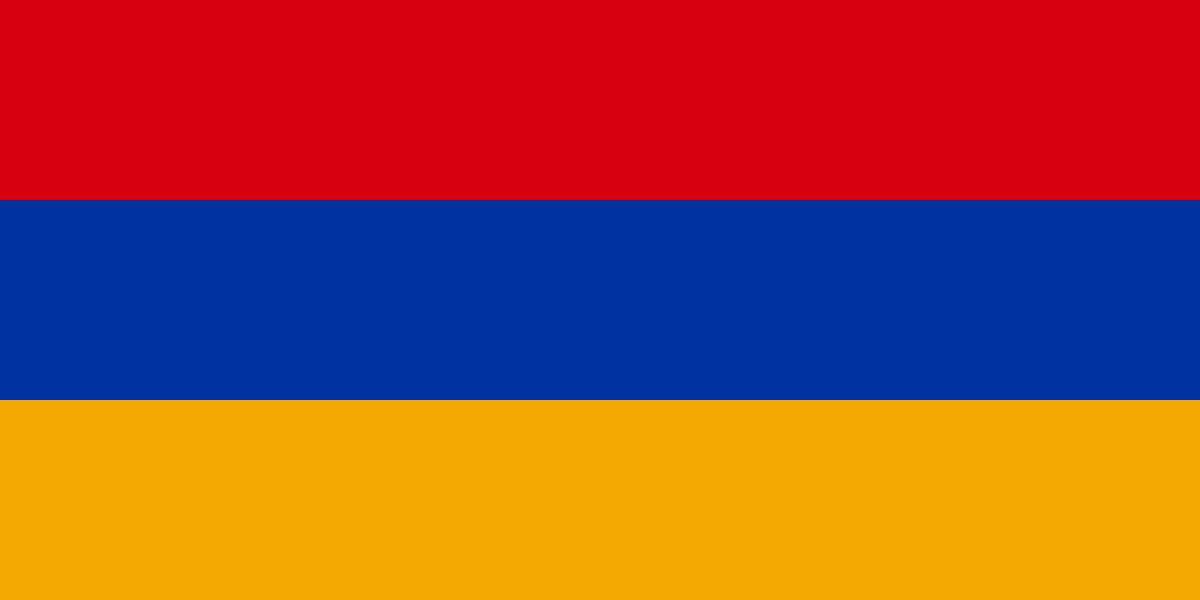
Armenia, formally the Republic of Armenia, is a landlocked republic in Western Asia's Armenian Highlands. It is part of the Caucasus area and is bounded on the west by Turkey, on the north by Georgia, on the east by Azerbaijan and the Lachin corridor, and on the south by Iran and the Azerbaijani exclave of Nakhchivan. The capital and biggest city is Yerevan.
Armenia is a unitary, multi-party, democratic nation-state with a long history. Urartu, the earliest Armenian state, was founded around 860 BC and was superseded by the Satrapy of Armenia by the 6th century BC. The Kingdom of Armenia reached its apex under Tigranes the Great in the first century BC, becoming the world's first kingdom to accept Christianity as its official religion in 301. Around the early fifth century, the old Armenian monarchy was divided between the Byzantine and Sasanian Empires. The Bagratid Kingdom of Armenia was revived in the 9th century by the Bagratuni dynasty. The kingdom collapsed in 1045 as a result of conflicts against the Byzantines, and Armenia was shortly conquered by the Seljuk Turks. Between the 11th and 14th centuries, Cilician Armenia was an Armenian principality and eventually a kingdom on the Mediterranean Sea's coast.
Between the 16th and 19th centuries, the historic Armenian heartland of Eastern and Western Armenia was dominated by the Ottoman and Persian empires, which alternated sovereignty throughout the ages. By the nineteenth century, the Russian Empire had overrun Eastern Armenia, while the majority of the western regions of the old Armenian territory remained under Ottoman control. The Armenian genocide occurred during World War I, when 1.5 million Armenians residing in their ancestral territories in the Ottoman Empire were methodically slaughtered. Following the Russian Revolution in 1918, all non-Russian nations proclaimed their independence, resulting in the foundation of the First Republic of Armenia. The state was absorbed into the Transcaucasian Socialist Federative Soviet Republic by 1920, and it became a founding member of the Soviet Union in 1922. Transcaucasia was dissolved in 1936, converting its component nations, notably the Armenian Soviet Socialist Republic, into complete Union republics. During the breakup of the Soviet Union in 1991, the current Republic of Armenia gained independence.
Armenia is a developing nation that ranks 81st on the Human Development Index (2018). Its economy is based mostly on industrial production and mineral exploitation. Despite its physical location in the South Caucasus, Armenia is widely seen as geopolitically European. Armenia is a member of various European organizations, including the Council of Europe, the Eastern Partnership, Eurocontrol, the Assembly of European Regions, and the European Bank for Reconstruction and Development, since it is geopolitically aligned with Europe in many ways. Armenia is also a member of many Eurasia-wide regional organizations, including the Asian Development Bank, the Collective Security Treaty Organization, the Eurasian Union, and the Eurasian Development Bank. Armenia backs Artsakh's de facto independence, which was declared in 1991. Armenia also recognizes the Armenian Apostolic Church, the world's oldest national church, as the fundamental religious institution of the country. Mesrop Mashtots invented the Armenian script in 405 AD.