Bermuda is a British Overseas Territory in the North Atlantic Ocean. It was once known as the Bermudas or Somers Isles. Outside the territory, the nearest land is in the American state of North Carolina, some 1,035 kilometers (643 miles) to the west-northwest.
Bermuda is an archipelago of 181 islands, yet the most important islands are linked by bridges and seem to form a single mainland. It covers an area of 54 square kilometers (21 sq mi). Bermuda's climate is subtropical, having moderate winters and summers. Its climate has oceanic characteristics comparable to other coastal places in the Northern Hemisphere, with warm, moist air from the ocean maintaining relatively high humidity and temperature stability. Bermuda is located in Hurricane Alley, making it vulnerable to severe weather; nevertheless, it is protected by a coral reef and its location to the north of the belt, which restricts the direction and strength of oncoming hurricanes.
Bermuda was named after the Spanish adventurer Juan de Bermudez, who found the territory in 1505. Since 1612, when an English colony was formed at St. George's, the islands have been continually inhabited. Bermuda was a part of British America until 1684 when it became a crown colony under a royal charter by the Somers Isles Company. The first African slaves were brought to Bermuda in 1616, but a comprehensive plantation economy never developed, and the slave trade had mostly died out by the end of the 17th century. Instead, the economy grew centered on the sea, with the colony acting as a base for merchants, privateers, and the Royal Navy, and giving rise to the Bermuda rig and Bermuda sloop. After the United States gained freedom, it became an Imperial stronghold, the most significant British naval and military post in the Western Hemisphere, with massive amounts expended on its Royal Naval Dockyard and military defenses. Since the nineteenth century, tourism has been an important contribution to Bermuda's economy, and during World War II, the island became a prominent offshore financial hub and tax haven.
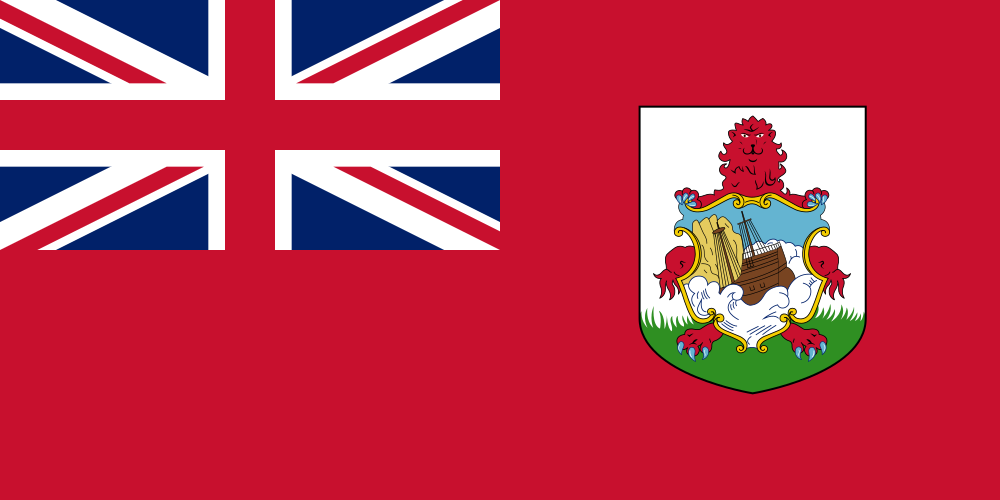
Bermuda, which is divided into nine parishes, is a self-governing parliamentary democracy with a bicameral parliament in the capital Hamilton. The House of Assembly has been in existence since 1620, making it one of the world's oldest legislatures. The governor, who is selected by the British government as the Queen's envoy, legally appoints the premier as the head of government. The United Kingdom is in charge of foreign policy and defense. In 1995, an independence referendum was conducted, with a strong majority voting against it.
Bermuda has a population of 71,176 people as of July 2018, making it the most populated of the British overseas territories. Black Bermudians (descendants of free and enslaved Latin Americans and Anglo-Americans with African ancestry, Africans, Europeans - particularly from the British Isles and the Portuguese Atlantic islands, and Native Americans) account for roughly half of the population, while White Bermudians (primarily of British, Irish, and Portuguese descent) account for the remaining 30%. There are smaller groups of people of different races or who identify as mixed race, and around 30% of the population is not Bermudian by birth (including both residents who have obtained Bermudian status otherwise than by descent and those who do not have Bermudian status). Bermuda has its own English accent and has always maintained strong relations with other English-speaking nations in the Americas, such as the United States, Canada, and the Commonwealth Caribbean. It is a member of the Caribbean Community as an associate member.