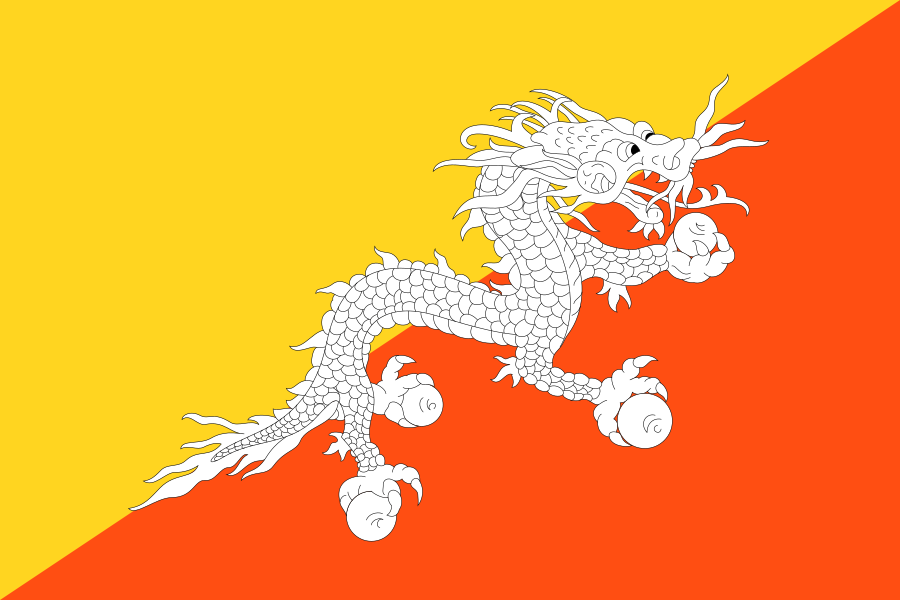
Bhutan, formally known as the Kingdom of Bhutan, is a landlocked nation in the Eastern Himalayas situated in the geographical subregion of Southern Asia between China and India. Bhutan is known as the "Land of the Thunder Dragon," or "Druk Yul." Although Nepal and Bangladesh are close neighbors, they do not share a geographical boundary. The nation has a population of about 754,000 people and a land area of 38,394 square kilometers (14,824 square miles), ranking 133rd in terms of land area and 160th in terms of population. Bhutan is a constitutional monarchy and the national religion is Vajrayana Buddhism.
The country's lush subtropical lowlands in the south give way to the subalpine Himalayan mountains in the north. There are peaks in Bhutan's Himalayas that rise more than 7,000 meters (23,000 feet) above sea level. Gangkhar Puensum is Bhutan's highest peak and the world's highest unclimbed mountain. Bhutan's fauna is noted for its richness, notably the Himalayan takin. Thimphu is the capital and biggest city.
Bhutan and adjacent Tibet saw the expansion of Buddhism, which started in the Indian subcontinent during Gautama Buddha's lifetime. The Vajrayana style of Buddhism spread to Bhutan from the southern Pala Empire of Bengal in the first century. During the fall of Buddhism in India, Tibet, Bhutan, Sikkim, and portions of Nepal were the last bastions of the Mahayana schools. Bhutan was also influenced by the Tibetan Empire. Ngawang Namgyal united the valleys of Bhutan into a single empire in the 16th century. Namgyal repulsed three Tibetan invasions, conquered competing religious schools, formalized the Tsa Yig legal system, and formed a theocratic and civil administration regime. Namgyal was the first Zhabdrung Rinpoche, and his successors served as Bhutan's spiritual leaders, similar to the Dalai Lama in Tibet. During the 17th century, Bhutan ruled over huge sections of northeast India, Sikkim, and Nepal, as well as Cooch Behar State. During the Bhutan War in the nineteenth century, Bhutan relinquished the Bengal Duars to British India. The House of Wangchuck ascended to the throne and strengthened links with the British in the subcontinent. A pact signed in 1910 provided British foreign policy guidance in return for domestic autonomy in Bhutan. The agreement was maintained via a new treaty with India in 1949, in which both nations acknowledged the sovereignty of the other. Bhutan became a member of the United Nations in 1971. Since then, it has strengthened ties with 55 nations, including Bangladesh, Israel, Kuwait, Brazil, Japan, Thailand, and Turkey, as well as the European Union. Bhutan retains its own military divisions despite its reliance on the Indian military.
The 2008 Constitution creates a parliamentary administration with an elected National Assembly and National Council. Bhutan founded the South Asian Association for Regional Cooperation (SAARC). Bhutan placed third in South Asia on the Human Development Index in 2020, after only Sri Lanka and the Maldives. Bhutan also belongs to the Climate Vulnerable Forum, the Non-Aligned Movement, BIMSTEC, the International Monetary Fund, the World Bank, UNESCO, and the World Health Organization (WHO). In 2016, Bhutan was rated top in SAARC for economic freedom, ease of doing business, peace, and absence of corruption. Bhutan boasts one of the world's greatest hydroelectric water supplies. Climate change-related glacier melting is a major problem in Bhutan.