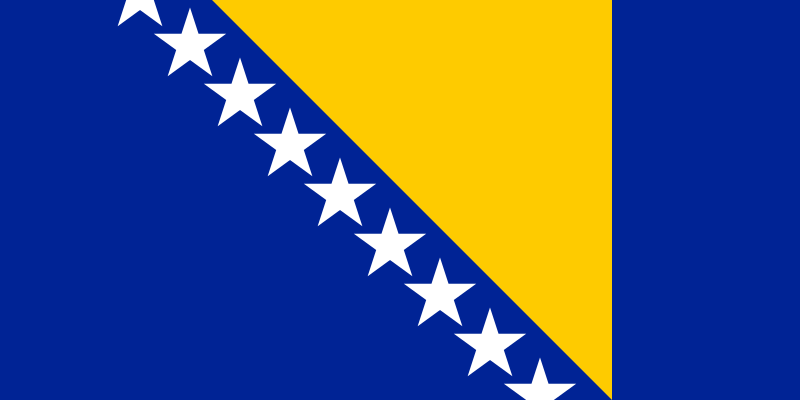
Bosnia and Herzegovina is a Balkan nation situated at the crossroads of south and southeast Europe. Sarajevo is the capital and biggest city. Bosnia and Herzegovina is bounded to the east by Serbia, to the southeast by Montenegro, and to the north and southwest by Croatia. It is not fully landlocked; towards the south, it has a 20-kilometer (12-mile)-long Adriatic Sea shoreline inside the Mediterranean that borders the town of Neum. Bosnia, the country's interior portion, has a mild continental climate with scorching summers and cold, snowy winters. The terrain of the nation is mountainous in the central and eastern areas, fairly hilly in the northwest, and mostly flat in the northeast. Herzegovina, the country's smaller, southern portion, has a Mediterranean climate and is primarily hilly.
The territory that is now Bosnia and Herzegovina has been inhabited by humans since at least the Upper Paleolithic, although evidence shows that permanent human settlements were created during the Neolithic period, including those belonging to the Butmir, Kakanj, and Vuedol cultures. Several Illyrian and Celtic civilizations settled in the region after the advent of the earliest Indo-Europeans. The nation has a rich and varied cultural, political, and social history. The ancestors of the South Slavic peoples that live in the region now came between the sixth and ninth centuries. The Banate of Bosnia was created in the 12th century, and by the 14th century, it had grown into the Kingdom of Bosnia. It was acquired by the Ottoman Empire in the mid-15th century and remained under its dominion until the late 19th century. The Ottomans introduced Islam to the area, transforming the country's cultural and social viewpoint.
The country was absorbed by the Austro-Hungarian monarchy from the late nineteenth century until World War I. Bosnia and Herzegovina was a province of the Kingdom of Yugoslavia during the interwar era. It was accorded full republic status in the newly founded Socialist Federal Republic of Yugoslavia after World War II. Following the disintegration of Yugoslavia in 1992, the republic declared independence. Following this came the Bosnian War, which lasted until late 1995 and was ended with the signing of the Dayton Agreement.
Today, the nation is home to three major ethnic groups, referred to in the constitution as "constituent peoples." Bosniaks are the most numerous of the three ethnic groups, followed by Serbs and Croats. In English, all Bosnians, regardless of ethnicity, are referred to as Bosnians. Minorities classified as "others" in the constitution include Jews, Roma, Albanians, Montenegrins, Ukrainians, and Turks.
Bosnia and Herzegovina has a bicameral legislature and a three-person president comprised of one representative from each of the three main ethnic groups. However, since the nation is primarily decentralized, the central government's role is severely constrained. It is made up of two independent organizations, the Federation of Bosnia and Herzegovina and Republika Srpska, as well as a third entity, the Brčko District, which has its own municipal administration. The Federation of Bosnia and Herzegovina is also made up of ten cantons.
Bosnia and Herzegovina is a developing nation that ranks 73rd in the world in terms of human development. Industry and agriculture dominate its economy, followed by tourism and the service sector. Tourism has grown dramatically in recent years. The nation boasts a social security and a universal-healthcare system, as well as free elementary and secondary education. It belongs to the United Nations, the Organization for Security and Cooperation in Europe, the Council of Europe, the Partnership for Peace, and the Central European Free Trade Agreement; it is also a founding member of the Union for the Mediterranean, which was founded in July 2008. The nation is a candidate for European Union membership and a candidate for NATO membership since April 2010, when it got a Membership Action Plan.