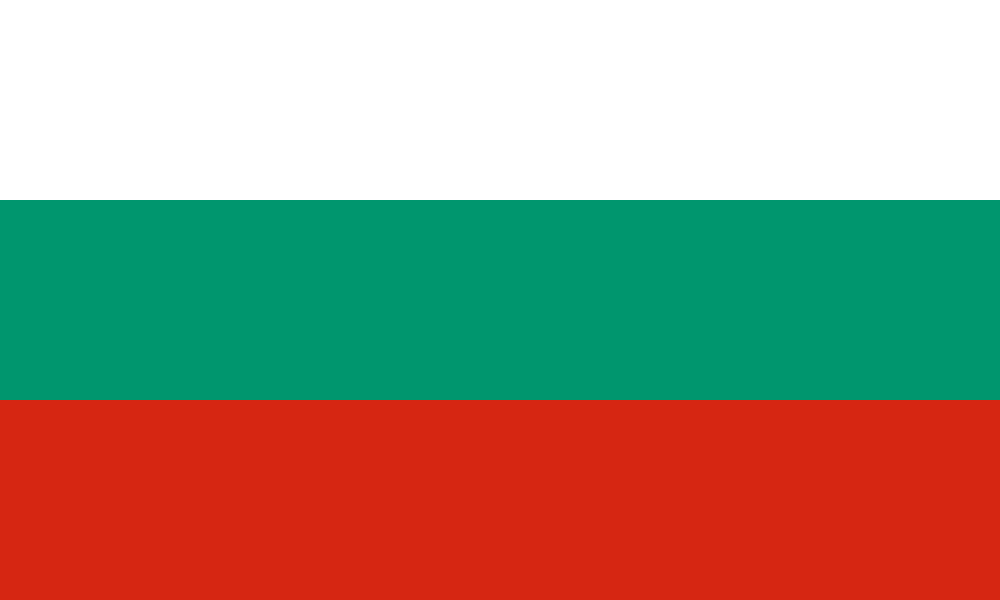
Bulgaria, formally the Republic of Bulgaria, is a Southeast European nation. It encompasses the whole eastern Balkans and is bounded to the north by Romania, to the west by Serbia and North Macedonia, to the south by Greece and Turkey, and to the east by the Black Sea. Bulgaria is the sixteenth-largest nation in Europe, with a land area of 110,994 square kilometers (42,855 square miles). Sofia is the capital and biggest city of Bulgaria; other notable cities include Plovdiv, Varna, and Burgas.
The Neolithic Karanovo civilization, which dates back to 6,500 BC, was one of the first cultures in modern-day Bulgaria. The territory was a battlefield for ancient Thracians, Persians, Celts, and Macedonians from the sixth to third centuries BC; stability arrived with the Roman Empire's conquest of the province in AD 45. Tribal assaults in the area continued when the Roman state disintegrated. These lands were colonized by the early Slavs about the 6th century. In the late 7th century, the Bulgars commanded by Asparuh of Bulgaria launched an offensive from the regions of (Old Great) Bulgaria and permanently conquered the Balkans. They formed (Danubian) Bulgaria, which was successful in a pact with the Eastern Roman Empire in AD 681. It governed the majority of the Balkans and had a huge impact on Slavic civilizations by establishing the Cyrillic alphabet. The First Bulgarian Empire existed until the early 11th century when it was captured and destroyed by Byzantine emperor Basil II. In 1185, a victorious Bulgarian insurrection formed the Second Bulgarian Empire, which peaked under Ivan Asen II (1218–1241). The empire dissolved in 1396, after multiple arduous battles and feudal struggle, and came under Ottoman authority for over five centuries.
The third and present Bulgarian state was formed as a consequence of the Russo-Turkish War of 1877–78. Many ethnic Bulgarians were left outside the boundaries of the new country, fueling irredentist sentiments that led to many clashes with its neighbors and alliances with Germany in both world wars. Bulgaria joined the Soviet-led Eastern Bloc in 1946 and became a socialist state. Following the upheavals of 1989, the governing Communist Party relinquished its monopoly on power and permitted multiparty elections. Bulgaria thereafter became a democracy with a market-based economy. Bulgaria has been a unitary parliamentary republic comprising 28 provinces since the adoption of a democratic constitution in 1991, with a high degree of political, administrative, and economic centralization.
Bulgaria, which ranks 56th on the Human Development Index, is a developing nation with an upper-middle-income economy. Its market economy is a member of the European Union and is mostly centered on services, followed by industry (particularly machine building and mining) and agriculture. Corruption is a serious socioeconomic concern; in 2018, Bulgaria was regarded as the most corrupt nation in the European Union. The nation is also facing a demographic catastrophe, with its population declining year after year since approximately 1990; it now counts around seven million people, down from a high of over nine million in 1988. Bulgaria is a member of the European Union, NATO, and the Council of Europe, as well as a founding member of the OSCE and a three-time member of the United Nations Security Council.