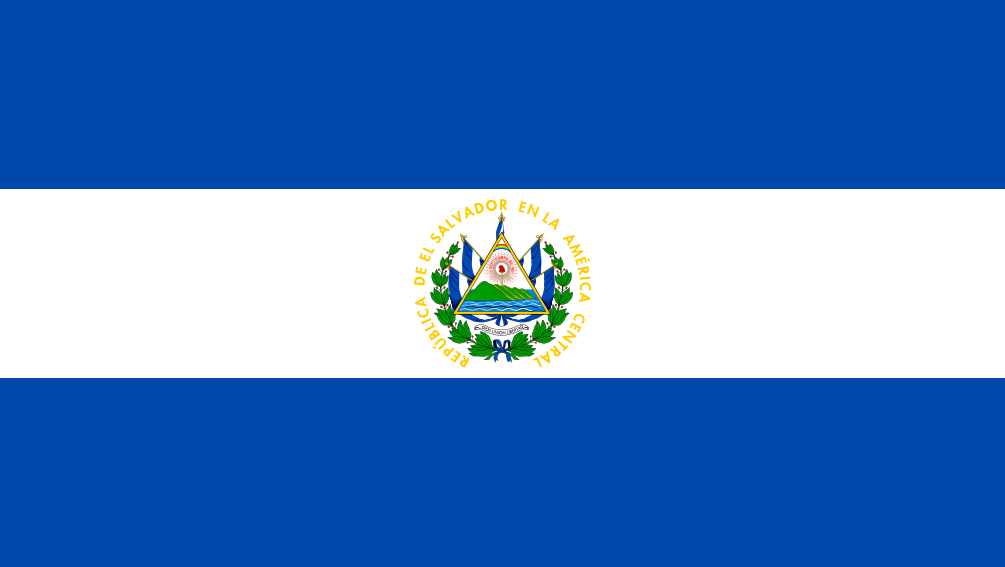
El Salvador (formally the Republic of El Salvador) is a Central American nation. It shares borders with Honduras in the northeast, Guatemala in the northwest, and the Pacific Ocean on the south. San Salvador is El Salvador's capital and biggest city. The country's population is expected to reach 6.8 million in 2021.
The Lenca (after 600 AD), Mayans, and eventually Cuzcatlecs were among the Mesoamerican nations that ruled the area. Archaeological evidence also points to an early Olmec presence in the first millennium BC. The Spanish Empire invaded Central America in the early 16th century, bringing it into the Viceroyalty of New Spain, which was controlled by Mexico City. The Viceroyalty of Mexico, on the other hand, had little to no impact on the day-to-day affairs of the isthmus, which was colonized in 1524. The Spanish designated the region to be the Captaincy General of Guatemala in 1609, which comprised the territory that would become El Salvador until its independence from Spain in 1821. It was forced into the First Mexican Empire until seceding and joining the Federal Republic of Central America in 1823. When the federation disbanded in 1841, El Salvador became an independent state, and later created the Greater Republic of Central America with Honduras and Nicaragua, which lasted from 1895 to 1898.
El Salvador had chronic political and economic instability from the late nineteenth to the mid-twentieth centuries, marked by coups, revolts, and a series of authoritarian regimes. Persistent socioeconomic disparity and social discontent culminated in the Salvadoran Civil War, which lasted from 1979 to 1992 and was fought between a military-led government supported by the US and a coalition of left-wing guerrilla organizations. The Chapultepec Peace Accords brought the fighting to a close. This negotiated agreement created a multiparty constitutional republic, which still exists today.
During the country's civil war, a considerable number of Salvadorans fled to the United States, becoming one of the country's biggest immigrant groups by 2008.
Agriculture has traditionally dominated El Salvador's economy, dating back to the 16th century when the Spanish took control of the indigenous cacao crop, with production focused in Izalco, as well as balsam from the ranges of La Libertad and Ahuachapan. This was followed by a surge in the usage of the indigo plant (ail in Spanish) in the nineteenth century, mostly for use as a dye. Following that, the emphasis turned to coffee, which accounted for 90 percent of export revenues by the early twentieth century. El Salvador has now lessened its reliance on coffee and begun diversifying its economy by growing the industrial sector and opening up trade and financial linkages. The colón, El Salvador's currency since 1892, was replaced by the US dollar in 2001.
The Human Development Index ranks El Salvador 124th out of 189 nations. El Salvador is the most egalitarian nation in Latin America in terms of economic inequality while having high rates of poverty and gang-related violent crime. El Salvador was one of the least difficult economies for conducting business among the 77 nations studied in 2021.