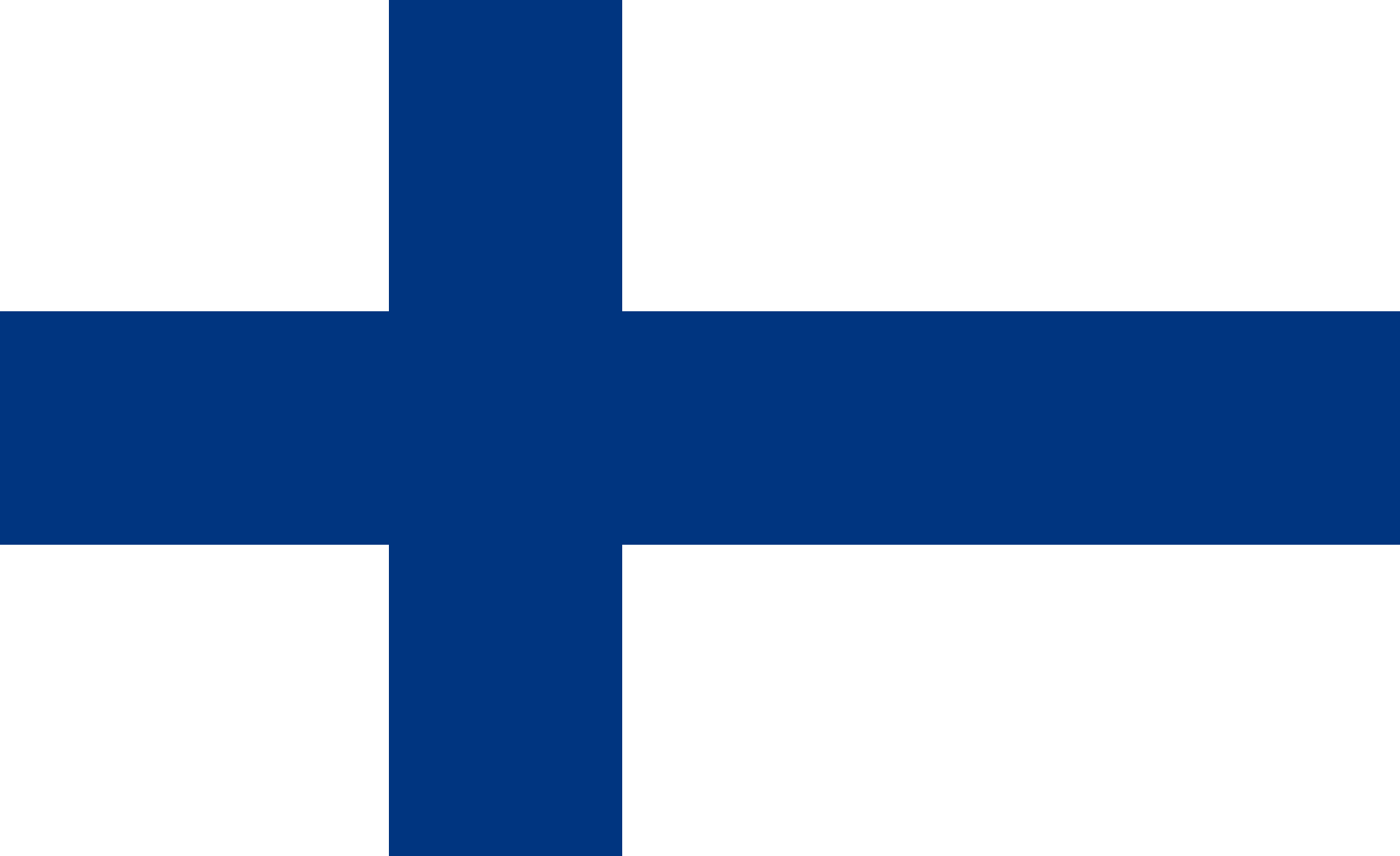
Finland is a Nordic nation in Northern Europe, formally known as the Republic of Finland. It shares land boundaries with Sweden to the northwest, Norway to the north, and Russia to the east, as well as the Gulf of Bothnia to the west and the Gulf of Finland to the south through Estonia. Finland has a population of 5.5 million people and an area of 338,455 square kilometers (130,678 square miles). Helsinki is the capital and biggest city, and it is part of a broader metropolitan region that includes the cities of Espoo, Kauniainen, and Vantaa. The ethnic Finns make up the large bulk of the population; Finnish and Swedish are the official languages. The climate of Finland ranges from humid continental in the south to boreal in the north. The land cover is largely a boreal woodland biome, with over 180,000 lakes reported.
Finland was originally populated circa 9000 BC, after the end of the Last Glacial Period. Several pottery types and civilizations emerged throughout the Stone Age. Contacts with different civilizations in Fennoscandia and the Baltic area were common throughout the Bronze and Iron Ages. As a result of the Northern Crusades, Finland eventually became an essential part of Sweden beginning in the late 13th century. As a consequence of the Finnish War, Finland became part of the Russian Empire in 1809 as the independent Grand Duchy of Finland, during which time Finnish art thrived and the concept of independence gained traction. Finland became the first European country to provide universal suffrage in 1906, and the first in the world to allow all adult citizens to run for public office. The last Tsar of Russia, Nicholas II, attempted to russify Finland and remove its political autonomy, but following the 1917 Russian Revolution, Finland proclaimed independence from Russia. The Finnish Civil War separated the young state in 1918. Finland battled the Soviet Union in the Winter War and the Continuation War, and Nazi Germany in the Lapland War during WWII. It later lost land, including the culturally and historically important town of Vyborg, but preserved its independence.
Until the 1950s, Finland was predominantly an agricultural nation. Following World War II, it swiftly industrialized and expanded its economy, while also establishing a comprehensive welfare state based on the Nordic model; the nation soon experienced broad affluence and a high per capita income. Finland joined the United Nations in 1955 and declared itself neutral; it joined the OECD in 1969, the NATO Partnership for Peace in 1994, the European Union in 1995, the Euro-Atlantic Partnership Council in 1997, and the Eurozone in 1999. Finland ranks first in a variety of national performance criteria, including education, economic competitiveness, civil freedoms, quality of life, and human development. Finland ranked first in the World Human Capital Report in 2015, first in the Press Freedom Index, and was the most stable country in the world from 2011 to 2016, according to the Fragile States Index; it is second in the Global Gender Gap Report, and first in every annual World Happiness Report since 2018.