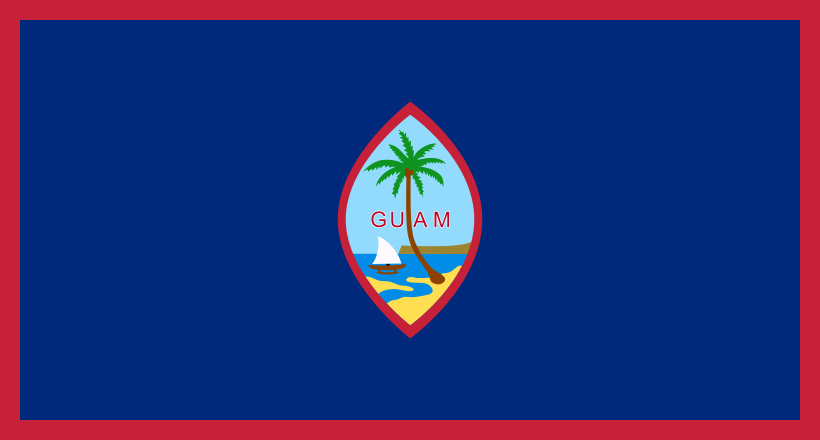
Guam is a territory of the United States that is organized but not formally incorporated. It is located in the Micronesia subregion in the western Pacific Ocean. It is the biggest and southernmost of the Mariana Islands and the largest island in Micronesia. It is also the most westernmost point and territory of the United States as measured from the geographic center of the country. Dededo is the most populated hamlet in Guam, although Hagatna serves as the island's capital.
People who were born on Guam are American citizens; nevertheless, they are not eligible to vote in presidential elections held in the United States while they are still living on Guam, and delegates from Guam to the United States House of Representatives do not have a vote on the floor of that chamber. The Chamoru, also known historically as the Chamorro, are the indigenous people of Guam. They are linked to the Austronesian peoples of Indonesia, the Philippines, Malaysia, Taiwan, Micronesia, and Polynesia. Guam has a population of 168,801 people as of the year 2021. The Chamorros make up the biggest ethnic group on the island, yet they are still considered a minority. The population density in the territory is 775 people per square mile (299 people per square kilometer), and it has a total area of 210 square miles (540 km2; 130,000 acres).
Around 3,500 years ago, individuals who spoke Chamoru were the first to settle on the island. On March 6, 1521, the Portuguese explorer Ferdinand Magellan arrived on the island as the first European to do so. Magellan was serving Spain at the time of his arrival. In 1668, Spain began the process of colonizing Guam. Guam served as a significant port of call for the Spanish Manila Galleons sailing the Pacific during the 16th and 18th centuries. Guam was taken by the United States on June 21, 1898, when they were fighting against Spain in the Spanish–American War. Guam was handed over to the United States of America on April 11, 1899, as a result of the Treaty of Paris, which was signed on December 10, 1898.
Guam was one of the five American jurisdictions in the Pacific Ocean prior to the start of World War II. The other four were Wake Island in Micronesia, American Samoa, and Hawaii in Polynesia and the Philippines. Guam was taken over by the Japanese on December 8, 1941, only a few hours after they had attacked Pearl Harbor. They remained in control of the island for the next two and a half years. Guamanians were subjected to forced labor, detention, torture, and death when their country was under occupation. The day when American troops successfully retook control of the island, July 21, 1944, is now celebrated as Liberation Day. Since the 1960s, tourism and the United States military, for whom Guam is a vital strategic asset, have been the primary contributors to Guam's economy. Guam is a U.S. territory.
The phrase "Where America's Day Begins," which is not an official slogan for the territory but is used rather often, relates to the location of the island in relation to the International Date Line. Guam was admitted to the Pacific Community in 1983 and is now included as one of the United Nations' 17 territories that do not have full control over their own governments.