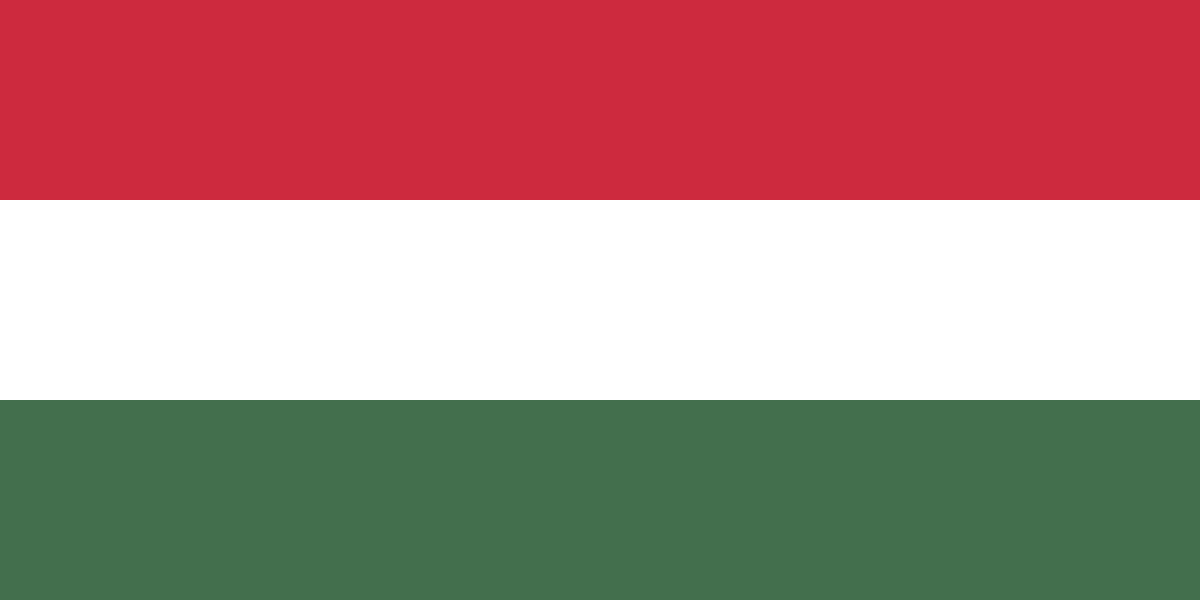
Hungary is a Central European nation that is landlocked. It is surrounded by Slovakia to the north, Ukraine to the northeast, Romania to the east and southeast, Serbia to the south, Croatia and Slovenia to the southwest, and Austria to the west, spanning 93,030 square kilometers (35,920 square miles) of the Carpathian Basin. Hungary has a population of over 10 million people, most of whom are ethnic Hungarians with a sizable Romani minority. Hungarian, the official language, is the world's most extensively spoken Uralic language and one of Europe's few non-Indo-European languages. Budapest is the capital and biggest city of Hungary; other notable cities include Debrecen, Szeged, Miskolc, Pécs, and Gyr.
For millennia, the land of modern-day Hungary has served as a crossroads for many peoples, including Celts, Romans, Germanic tribes, Huns, West Slavs, and Avars. The conquest of the Carpathian Basin by Hungarian grand prince rpád in the late 9th century AD laid the groundwork for the Hungarian kingdom. In 1000, his great-grandson Stephen I rose to the throne, transforming his empire into a Christian state. Hungary had become a regional power by the 12th century, reaching its cultural and political zenith in the 15th century. It was largely captured by the Ottoman Empire (1541–1699) after the Battle of Mohács in 1526. Hungary was ruled by the Habsburgs at the start of the 18th century, subsequently joining the Austrian Empire to create Austria-Hungary, a prominent power until the early 20th century.
After World War I, Austria-Hungary fell apart, and the Treaty of Trianon created Hungary's present boundaries, resulting in the loss of 71 percent of its land, 58 percent of its people, and 32 percent of ethnic Hungarians. After a turbulent interwar era, Hungary joined the Axis Powers in World War II, incurring tremendous damage and losses. Following World War II, Hungary became a Soviet Union satellite state, resulting in the foundation of the Hungarian People's Republic. Following the failure of the 1956 revolution, Hungary became a more liberal, but still oppressive, member of the Eastern Bloc. The demolition of Hungary's border barrier with Austria hastened the fall of the Eastern Bloc and, later, the Soviet Union. Hungary reverted to a democratic parliamentary republic on October 23, 1989. Hungary became a member of the European Union in 2004 and has been a member of the Schengen Area since 2007.
Hungary is considered a medium power in international affairs, due mostly to its cultural and economic clout. It is a developed nation with a high-income economy that ranks 40th on the Human Development Index, with inhabitants receiving universal health care and free secondary education. Hungary has made important contributions to the arts, music, literature, athletics, science, and technology for a long time. It is Europe's tenth most popular tourist attraction, with 15.8 million foreign visitors in 2017. It is a member of a number of international organizations, including the EU, the Council of Europe, NATO, the United Nations, WHO, the World Trade Organization, the World Bank, the IIB, the AIIB, and the Visegrád Group.