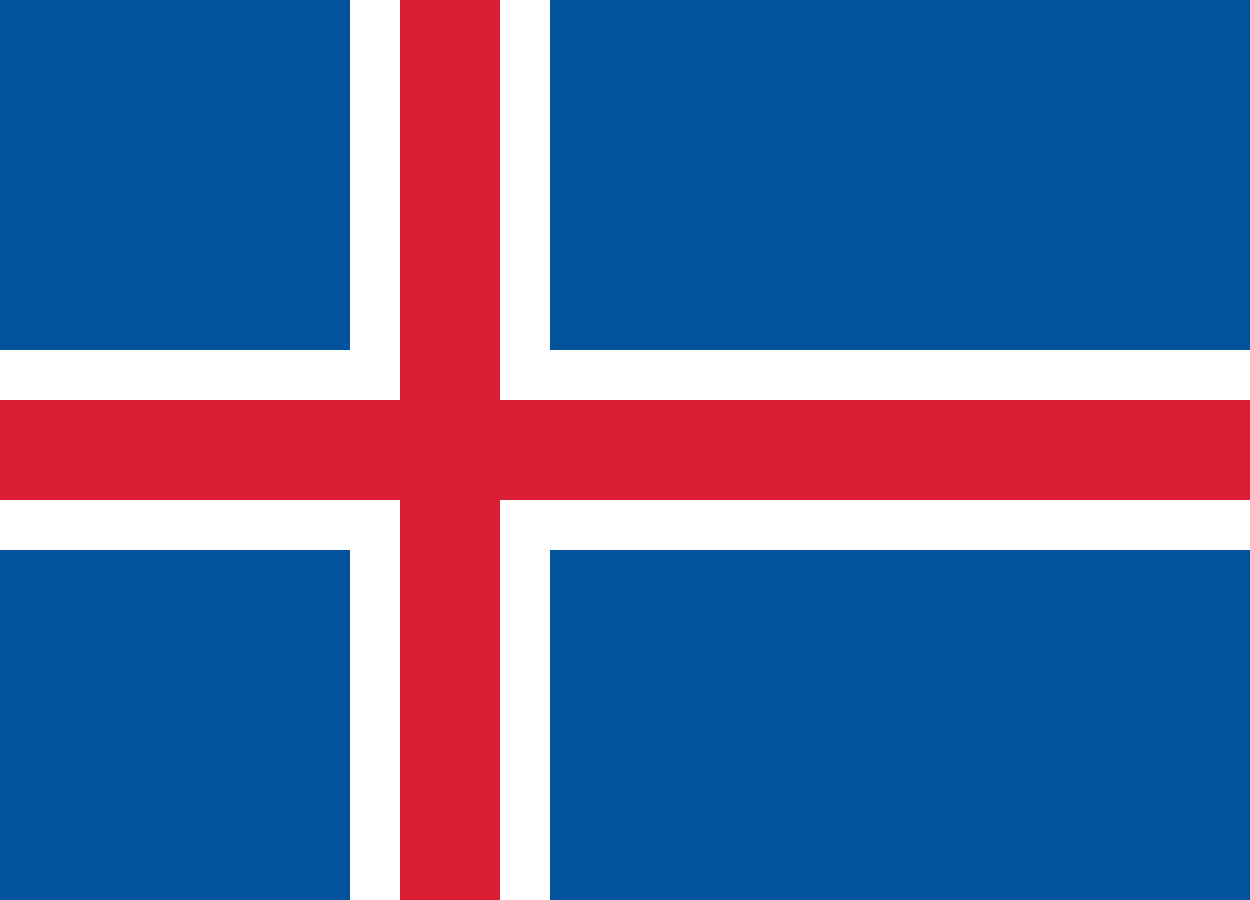
Iceland is a Nordic island republic in the North Atlantic Ocean with the fewest people in Europe. Reykjavik, Iceland's capital and biggest city, is home to more than 65 percent of the country's population (together with its surrounding territories). Iceland is the only segment of the Mid-Atlantic Ridge that rises above sea level, and its central volcanic plateau erupts almost every day. The interior is characterized by a plateau with sand and lava fields, mountains, and glaciers, with several glacial rivers flowing to the sea via the lowlands. Despite its high latitude close beyond the Arctic Circle, Iceland boasts a mild climate due to the Gulf Stream. Summers are cool due to its high latitude and marine influence, and most of its islands have a polar climate.
The colonization of Iceland started in 874 AD, according to the old text Landnámabók, when the Norwegian chieftain Ingólfr Arnarson became the first permanent resident on the island. Norwegians, and to a lesser degree other Scandinavians, came to Iceland in the following centuries, bringing with them thralls (slaves or serfs) of Gaelic ancestry.
The island was ruled as an autonomous nation by the Althing, one of the world's oldest operating legislative assemblies. Iceland surrendered to Norwegian power in the 13th century after a period of civil war. The Kalmar Union, founded in 1397, brought together the kingdoms of Norway, Denmark, and Sweden. Iceland therefore followed Norway's accession to the union, falling under Danish control upon Sweden's withdrawal from the union in 1523. In 1550, the Danish monarchy forcibly brought Lutheranism to Iceland.
Following the French Revolution and the Napoleonic Wars, Iceland's quest for independence took shape, culminating in 1918 with the foundation of the Kingdom of Iceland, which shared the current king of Denmark via a personal union. During the occupation of Denmark during WWII, Iceland decisively chose to become a republic in 1944, therefore breaking the last official links with Denmark. Despite the suspension of the Althing from 1799 to 1845, the island republic is recognized with preserving the world's oldest and longest-running parliament.
Iceland depended heavily on subsistence fishing and agriculture until the twentieth century. Following World War II, industrialization of the fisheries and Marshall Plan help provided prosperity, and Iceland rose to become one of the world's richest and most industrialized countries. It joined the European Economic Area in 1994, which expanded its economy into industries including as banking, biotechnology, and manufacturing.
Iceland has a market economy with minimal taxes in comparison to other OECD nations, as well as the world's highest trade union membership. It retains a Nordic social welfare system that offers its residents with universal health care and tertiary education. Iceland scores high on democracy and equality indices, as well as third in the world in terms of median wealth per adult. The United Nations' Human Development Index placed it as the fourth-most developed nation in the world in 2020, and it ranks first on the Global Peace Index. Iceland is nearly entirely powered by renewable energy.
Icelandic culture is based on the country's Scandinavian roots. Icelandic, a North Germanic language evolved from Old West Norse and closely related to Faroese, is spoken by the majority of Icelanders. Traditional Icelandic food, Icelandic literature, and medieval sagas are among the country's cultural legacies. Iceland has the lowest population of any NATO member and is the only one that does not have a regular army, instead relying on a lightly armed coast guard.