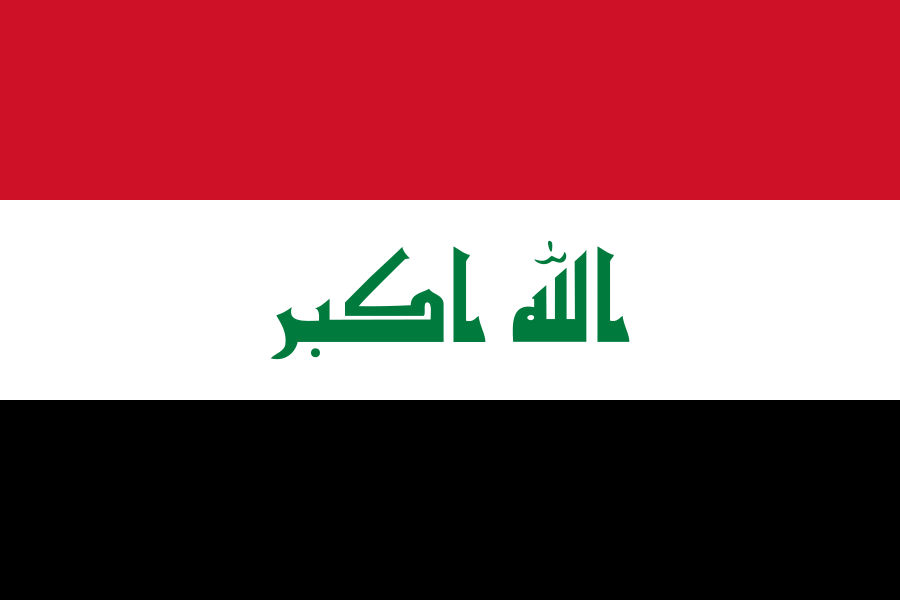
Iraq, officially the Republic of Iraq (Arabic: جُمْهُورِيَّة ٱلْعِرَاق Jumhūriīyet al-ʿIrāq; Kurdish: کۆماری عێراق, romanized: Komarî Êraq), is a nation in Western Asia. It is bounded to the north by Turkey, to the east by Iran, to the southeast by the Persian Gulf and Kuwait, to the south by Saudi Arabia, to the southwest by Jordan, and to the west by Syria. Baghdad is the capital and biggest city. Iraq has a varied ethnic population, including Arabs, Kurds, Turkmens, Assyrians, Armenians, Yazidis, Sabian-Mandaeans, Persians, and Shabakis, as well as a diversified environment and animals. The majority of the country's 40 million residents are Muslims, with Christianity, Yazidism, Mandaeism, Yarsanism, and Zoroastrianism all being recognized faiths. Iraq's official languages are Arabic and Kurdish, with English, Neo-Aramaic, Turkish, and Armenian as recognized regional languages.
Mesopotamia ("Land Between the Rivers") was an area whose enormous alluvial plains gave home to some of the world's first civilizations and empires from the 6th millennium BC, including those of Akkad, Babylon, Assyria, and Sumer, the earliest known civilization. The region covering current Iraq is known as the "Cradle of Civilisation," because it was the origin of many key innovations and discoveries, including the writing system, arithmetic, time, calendar, astrology, and the legal code. It was at Uruk that humanity first learned to read, write, form laws, and live in cities governed by an organized government. Baghdad became the capital and largest city of the Abbasid Caliphate following the Muslim conquest of Mesopotamia, and during the Islamic Golden Age, the city evolved into a significant cultural and intellectual center, earning it a worldwide reputation for its academic institutions, including the House of Wisdom. The city was substantially devastated by the Mongol Empire during the Siege of Baghdad in 1258, resulting in a downfall that would last for centuries owing to recurrent plagues and many successor dynasties.
Modern Iraq dates from 1920, when the British Mandate for Mesopotamia was established under the authority of the League of Nations, combining three Ottoman vilayets. Faisal I of Iraq founded the British-backed Kingdom in 1921. In 1932, the Hashemite Kingdom of Iraq declared independence from the United Kingdom. The monarchy was deposed in 1958, and the Iraqi Republic was established. From 1968 until 2003, Iraq was ruled by the Arab Socialist Ba'ath Party. Iraq attacked Iran in 1980, igniting a lengthy conflict that would endure almost eight years and conclude in a stalemate with horrific casualties for both nations. Saddam Hussein's Ba'ath Party was deposed after an invasion by the United States and its allies in 2003, and multi-party parliamentary elections were conducted in 2005. The US engagement in Iraq came to an end in 2011.
Iraq is a parliamentary federal republic. The president is the head of state, while the prime minister is the head of government. The constitution also establishes two deliberative bodies, the Council of Representatives and the Council of Union. The judiciary is independent of the executive and legislative branches.
Iraq is seen as a growing middle power with a strategic position, and it is a founding member of the United Nations, OPEC, the Arab League, the OIC, the Non-Aligned Movement, and the IMF. Iraq's political history has been marked by times of tremendous economic and military expansion, as well as periods of political and economic turmoil, since its independence.