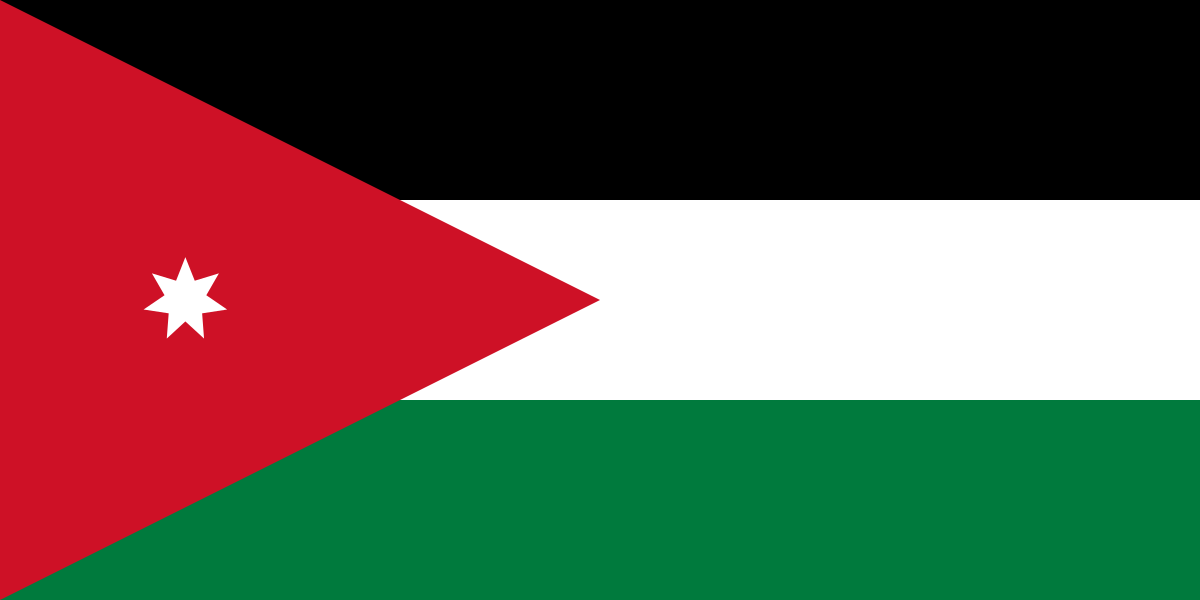
Jordan is a nation in Western Asia. Its official name is the Hashemite Kingdom of Jordan. It is located on the East Bank of the Jordan River, at the crossroads of Asia, Africa, and Europe, in the Levant area. Jordan is bounded to the south and east by Saudi Arabia, to the northeast by Iraq, to the north by Syria, and to the west by the Palestinian West Bank, Israel, and the Dead Sea. To the southwest, it has a 26-kilometer (16-mile) shoreline on the Gulf of Aqaba in the Red Sea. Jordan and Egypt are separated by the Gulf of Aqaba. Amman is the capital and biggest city of Jordan, as well as the country's economic, political, and cultural center.
Humans have been present in Jordan since the Paleolithic epoch. At the conclusion of the Bronze Age, three stable kingdoms emerged: Ammon, Moab, and Edom. The Assyrian Empire, Babylonian Empire, Nabataean Kingdom, Persian Empire, Roman Empire, Rashidun, Umayyad, Abbasid Caliphates, and Ottoman Empire were later rulers. Following the Great Arab Revolt against the Ottomans in 1916 during World War I, Britain and France partitioned the Ottoman Empire. The Hashemite, then Emir, Abdullah I, formed the Emirate of Transjordan in 1921, and the emirate became a British protectorate. Jordan established an independent state in 1946, officially known as the Hashemite Kingdom of Transjordan, but it was renamed the Hashemite Kingdom of Jordan in 1949 when the nation invaded and annexed the West Bank during the 1948 Arab–Israeli War and lost it to Israel in 1967. Jordan relinquished its claim to the area in 1988, and in 1994, it became the second Arab state to sign a peace deal with Israel. Jordan is an Arab League and Organization of Islamic Cooperation founding member. The sovereign state is a constitutional monarchy, although the king has extensive administrative and legislative authority.
Jordan is a semi-arid nation with a population of 10 million people and an area of 89,342 km2 (34,495 sq mi). It is the eleventh most populated Arab country. The majority, or around 95 percent of the country's population, is Sunni Muslim, with a mostly Arab Christian minority. Jordan has been described as an "oasis of stability" amid the volatile Middle East area. It escaped the unrest that engulfed the area during the Arab Spring in 2010. Jordan has admitted refugees from a number of conflict-torn neighboring nations since 1948. According to a 2015 census, Jordan has an estimated 2.1 million Palestinian and 1.4 million Syrian refugees. Thousands of Christian Iraqis escaping persecution by the Islamic State have also sought safety in the monarchy. While Jordan continues to welcome migrants, the current big inflow from Syria has put significant pressure on the country's resources and infrastructure.
Jordan ranks 102nd on the Human Development Index and is considered an upper-middle-income economy. The Jordanian economy, while being one of the smallest in the area, is appealing to international investors due to its competent workforce. Because of its highly-developed health sector, the country is a popular tourist destination, as well as a medical tourism destination. Nonetheless, a scarcity of natural resources, a massive influx of migrants, and regional unrest have stifled economic progress.