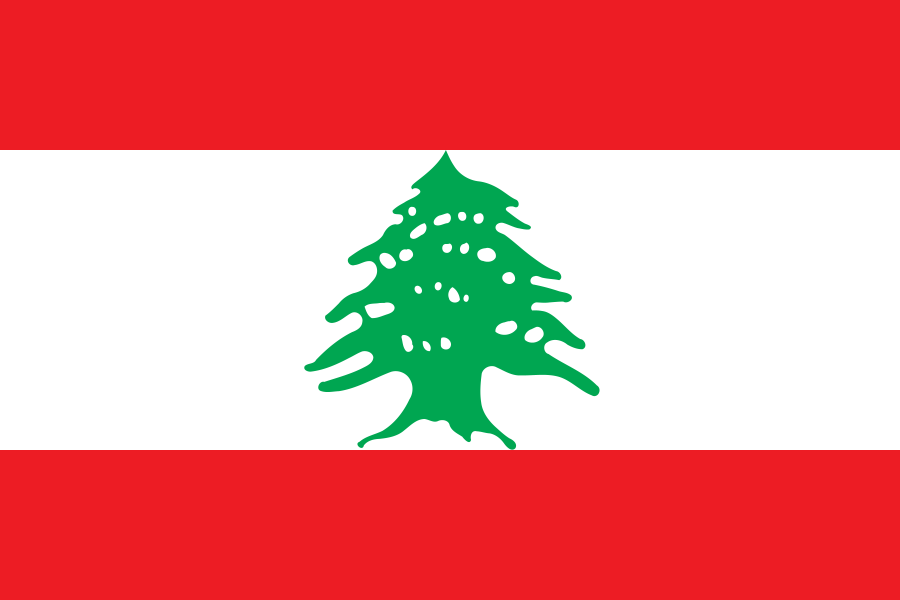
Lebanon, often known as the Lebanese Republic or the Republic of Lebanon, is a nation in Western Asia. It is bounded to the north and east by Syria and to the south by Israel, with Cyprus to the west across the Mediterranean Sea; its position at the crossroads of the Mediterranean Basin and the Arabian hinterland has contributed to its rich past and formed a religiously diverse cultural identity. Lebanon has a population of around six million people and an area of 10,452 square kilometers (4,036 square miles), making it one of the world's smallest nations. The state's official language is Arabic, however, French is also nominally recognized; the Lebanese dialect of Arabic is spoken across the nation alongside Modern Standard Arabic.
The oldest trace of civilization in Lebanon predates documented history by about 7000 years. The Phoenicians, a maritime society that lasted for about 3000 years (c. 3200–539 BCE), lived in modern-day Lebanon. The Roman Empire seized the province in 64 BCE, and it ultimately became one of the empire's primary centers of Christianity. The Mount Lebanon range witnessed the birth of the Maronite Church, a monastic institution. The Maronites retained their faith and identity when the territory was conquered by the early Arab Muslims. However, a new religious sect known as the Druze later established themselves in Mount Lebanon as well, resulting in a centuries-long religious division. The Maronites re-established communication with the Roman Catholic Church and emphasized their communion with Rome during the Crusades. In the early eighteenth century, the Maronite Catholics and the Druze established modern Lebanon via the "Maronite-Druze dualism" in Mount Lebanon Mutasarrifate.
The Ottoman Empire seized Lebanon in the 16th century and ruled it for the following 400 years. During the fall of the Ottoman Empire following World War I, the five Ottoman provinces that comprise modern-day Lebanon were placed under the French Mandate for Syria and Lebanon, under which the French-ruled precursor state of Greater Lebanon was founded. Following Nazi Germany's invasion and occupation of the French Third Republic during World War II, French control over the area diminished. Lebanon adopted a unique confessionalist style of government after obtaining independence from Free France in 1943, with particular governmental powers assigned to the state's main religious sects. Lebanon was very steady at first. This calm was short-lived and was eventually disrupted by the start of large-scale violence between different political and sectarian groups during the Lebanese Civil War (1975–1990). Lebanon was also subjected to overlapping foreign military occupations by Syria from 1976 to 2005 and by Israel from 1985 to 2000 during this time period. There have been substantial attempts to recover the economy and reconstruct national infrastructure after the war's conclusion.
Lebanon is a developing nation, ranked 92nd on the Human Development Index and ranking among the top in the Arab world outside of the Persian Gulf's oil-rich economy. It is considered a state with an upper medium income. However, the Lebanese liquidity crisis, corruption, and recent events have resulted in currency collapse, political insecurity, severe shortages, high unemployment, and poverty. Despite its modest population, Lebanese culture is well-known in the Middle East and across the world, thanks largely to its large diaspora. Lebanon is a founding member of the UN and a member of the Arab League, the Non-Aligned Movement, the Organization of Islamic Cooperation, and the Organisation Internationale de la Francophonie.