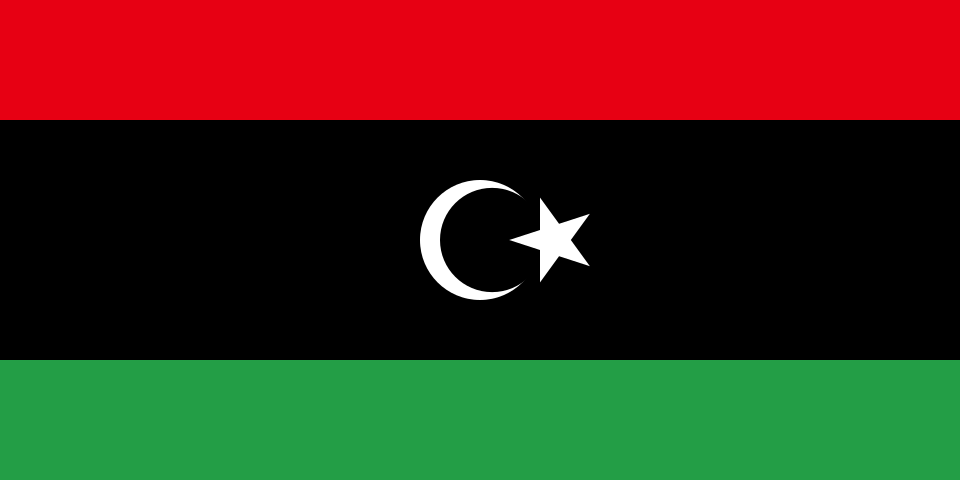
Libya is a nation in North Africa's Maghreb area. It is bounded to the north by the Mediterranean Sea, to the east by Egypt, to the southeast by Sudan, to the south by Chad, to the southwest by Niger, to the west by Algeria, and to the northwest by Tunisia. Tripolitania, Fezzan, and Cyrenaica are the three historical regions of Libya. It is the fourth-largest nation in Africa and the Arab world, and the 16th-largest in the globe, with an area of almost 700,000 square miles (1.8 million km2). Libya has the world's tenth-largest proven oil reserves. Tripoli, Libya's main city and capital, is situated in western Libya and is home to nearly three million of the country's seven million inhabitants.
Berbers, descendants of Iberomaurusian and Capsian civilizations, have been in Libya since the late Bronze Age. The Phoenicians created city-states and trade stations in western Libya in ancient times, while the Ottoman Empire recently ruled Libya's northern shore. Before becoming a part of the Roman Empire, parts of Libya were governed by Carthaginians, Persians, Egyptians, and Macedonians. Libya was an early Christian center. Following the collapse of the Western Roman Empire, the Vandals dominated the province of Libya until the 7th century, when invasions introduced Islam to the region. The Spanish Empire and the Knights of St John held Tripoli until 1551, when Ottoman rule started. Libya was a participant in the 18th and 19th century Barbary Wars. Ottoman authority lasted until the Italo-Turkish War, when Italy occupied Libya and established two colonies, Italian Tripolitania and Italian Cyrenaica (1911–1934), which were eventually combined in the Italian Libya colony from 1934 to 1943.
Libya was a battleground in the North African Campaign during World War II. The Italian population then declined. Libya gained its independence as a monarchy in 1951. In 1969, a bloodless military revolution headed by Colonel Muammar Gaddafi toppled King Idris I and established a republic. Critics referred to Gaddafi as a tyrant, and he was one of the world's longest-serving non-royal leaders, reigning for 42 years. He governed until he was deposed and murdered in the Libyan Civil War in 2011 when power was passed to the General National Congress. By 2014, two competing governments claimed control of Libya, destabilizing the nation and sparking a second civil war, with portions of the country divided between the Tobruk and Tripoli administrations, as well as different tribal and Islamist militias. On October 23, 2020, the two major fighting parties agreed on a lasting truce, and a united government seized power.
Libya is a member of the United Nations, the Non-Aligned Movement, the African Union, the Arab League, the Organization of Islamic Cooperation, and OPEC. The official religion of Libya is Islam, with Sunni Muslims constituting 96.6 percent of the population.