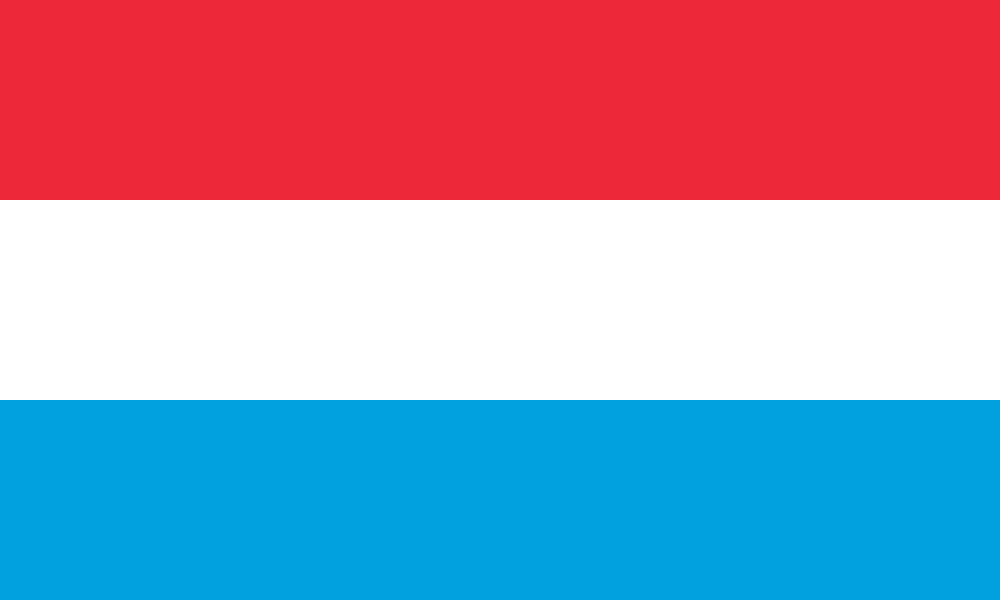
Luxembourg is a nation in Western Europe that is landlocked. It is bounded to the west and north by Belgium, to the east by Germany, and to the south by France. Luxembourg City, its capital and biggest city, is one of the four official capitals of the European Union (together with Brussels, Frankfurt, and Strasbourg) and the headquarters of various EU organizations, including the Court of Justice of the European Union, the highest judicial authority. While Luxembourgish is constitutionally the sole national language of the Luxembourgish people, French and German are also used in administrative and judicial issues, and all three are recognized administrative languages of the country.
Luxembourg is one of Europe's smallest sovereign republics, with an area of 2,586 square kilometers (998 square miles). It had a population of 645,397 in 2022, making it one of Europe's least populated nations, yet having the fastest population growth rate; immigrants make up about half of the population. Luxembourg is a constitutional monarchy led by Grand Duke Henri, making it the world's only surviving sovereign grand duchy. It is a developed nation with a developed economy and one of the highest GDP (PPP) per capita in the world. Due to the outstanding preservation of the massive fortifications and medieval neighborhoods, the City of Luxembourg was designated a UNESCO World Heritage Site in 1994.
Luxembourg's history is said to begin in 963, when count Siegfried purchased a rocky promontory and its Roman-era defenses, known as Lucilinburhuc, "small castle," and the surrounding land from the Imperial Abbey of St. Maximin in neighboring Trier. Through marriage, conquest, and vassalage, Siegfried's successors expanded their domain. The counts of Luxembourg ruled over a large region towards the end of the 13th century. In 1308, Count of Luxembourg Henry VII was crowned King of the Romans and subsequently Holy Roman Emperor; throughout the High Middle Ages, the House of Luxembourg produced four Holy Roman Emperors. Charles IV raised the county to the Duchy of Luxembourg in 1354. The duchy subsequently became a member of the Burgundian Circle and then one of the Habsburg Netherlands' Seventeen Provinces. The City and Fortress of Luxembourg, which was strategically important owing to its position between the Kingdom of France and the Habsburg possessions, was progressively built up over the ages to become one of Europe's most renowned fortresses. After being a member of both Louis XIV's France and Maria Theresa's Austria, Luxembourg became a component of Napoleon's First French Republic and Empire.
The current state of Luxembourg was established during the Congress of Vienna in 1815. With a Prussian force to secure the city from another French invasion, the Grand Duchy became an independent state under the personal control of William I of the Netherlands. Following the turbulence of the Belgian Revolution in 1839, the solely French-speaking half of Luxembourg was transferred to Belgium, and the Luxembourgish-speaking part (save for the Arelerland, the territory surrounding Arlon) became what is now Luxembourg.
Luxembourg is a founding member of the European Union, the Organization for Economic Cooperation and Development, the United Nations, NATO, and Benelux. It initially sat on the United Nations Security Council in 2013 and 2014. Luxembourg nationals enjoyed visa-free or visa-on-arrival access to 189 countries and territories as of 2022, placing the Luxembourgish passport third in the world, with Finland, Italy, and Spain.