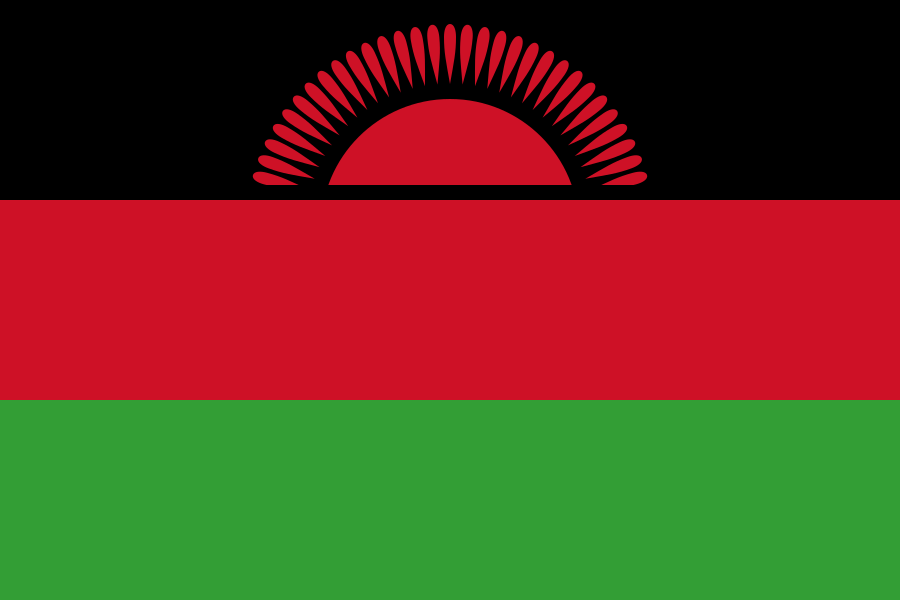
Malawi is a landlocked nation in Southeastern Africa that was originally known as Nyasaland. It is bounded on the west by Zambia, on the north and northeast by Tanzania, and on the east, south, and southwest by Mozambique. Malawi has a land area of 118,484 km2 (45,747 sq mi) and a population of 19,431,566 people (as of January 2021). Lilongwe is Malawi's capital (and biggest city). Its second-largest city is Blantyre, third-largest is Mzuzu, and fourth-largest is Zomba, its previous capital. Malawi derives its name from the Maravi, an ancient term for the Chewa people that live in the region. Because of its people's kindness, the nation is known as "The Warm Heart of Africa."
Migrating Bantu tribes inhabited the area that is now known as Malawi about the 10th century. Centuries later, in 1891, the British colonized the territory and established Nyasaland as a protectorate of the United Kingdom. It was proclaimed a protectorate under the semi-independent Federation of Rhodesia and Nyasaland in 1953. In 1963, the Federation was disbanded. The protectorate ended in 1964 when Nyasaland became an independent nation under Queen Elizabeth II and was called Malawi. It became a republic two years later. It obtained complete independence from the United Kingdom and, by 1970, had become a dictatorial one-party state under Hastings Banda's president, which he held until 1994. Malawi is now a democratic, multi-party country led by an elected president. Lazarus Chakwera of the Malawi Congress Party-led the Tonse Alliance coalition of nine political parties to victory in the court-mandated Presidential Election rerun conducted on June 23, 2020, after the annulment of the May 2019 Presidential Election due to severe voting irregularities. Malawi's military, the Malawian Defence Force, consists of an army, a navy, and an air wing. Malawi has a pro-Western foreign policy. It has good diplomatic relations with the majority of countries and is a member of several international organizations, including the United Nations, the Commonwealth of Nations, the Southern African Development Community (SADC), the Common Market for Eastern and Southern Africa (COMESA), and the African Union (AU).
Malawi is one of the world's poorest nations. The economy is strongly reliant on agriculture, and the population is mostly rural and fast-rising. Malawi's government is significantly reliant on foreign funding to satisfy its development requirements, albeit the quantity required (and the aid supplied) has dropped since 2000. Despite massive unemployment, the Malawian government confronts hurdles in its attempts to grow and expand the economy, enhance education, healthcare, and environmental protection, and achieve financial independence. Malawi has implemented many initiatives to address these concerns since 2005, and the country's outlook looks to be improving: In 2007 and 2008, key measures of economic, educational, and healthcare improvement were observed.
Malawi has a low birth rate and a high infant death rate. HIV/AIDS is widespread, reducing labor force participation and necessitating higher government spending. The country's population is diversified, including aboriginal peoples, Asians, and Europeans. There are many languages spoken, as well as a variety of religious beliefs. Although there had previously been a recurrent regional war caused in part by ethnic differences, by 2008, this internal struggle had significantly lessened, and the concept of identifying with one's Malawian nationality reemerged.