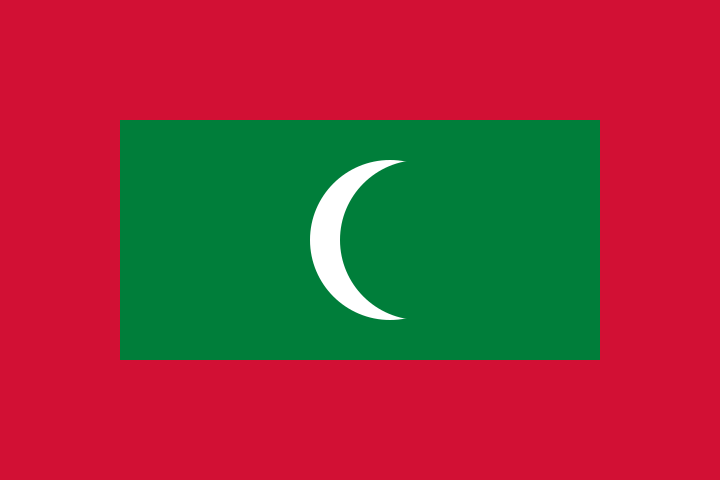
Maldives, formally the Republic of Maldives, is an archipelagic republic in Southern Asia's Indian subcontinent, located in the Indian Ocean. It's roughly 750 kilometers (470 miles; 400 nautical miles) from the Asian continent's mainland, southwest of Sri Lanka and India. The 26-atoll chain extends from Ihavandhippolhu Atoll in the north to Addu Atoll in the south (across the Equator).
Maldives is one of the world's most geographically dispersed sovereign states, with a territory spanning roughly 90,000 square kilometers (35,000 sq mi) including the sea, and the land area of all the islands comprises 298 square kilometers (115 sq mi). It is also one of the smallest Muslim-majority countries by land area, and the second least populous country in Asia, with around 557,751 inhabitants. Malé is the capital and most populous city, historically known as "King's Island" because of its central position, where ancient royal dynasties reigned.
The Maldivian Archipelago is situated on the Chagos–Laccadive Ridge, a huge undersea mountain range in the Indian Ocean that, together with the Chagos Archipelago and Lakshadweep, comprises a terrestrial ecoregion. It is the world's lowest-lying nation, with an average ground-level height of 1.5 meters (4 ft 11 in) above sea level and a maximum natural peak of just 2.4 meters.
The Maldivian Archipelago was cemented as a sultanate in the 12th century, maintaining strong trade and cultural relations with Asia and Africa. The area fell under the expanding influence of European colonial powers beginning in the mid-16th century, with the Maldives becoming a British protectorate in 1887. Independence from the United Kingdom was granted in 1965, and a presidential republic with an elected People's Majlis was founded in 1968. In the decades afterward, there has been political instability, democratic reform movements, and environmental difficulties brought by climate change.
The Maldives joined the South Asian Association for Regional Cooperation as a founding member (SAARC). It also belongs to the UN, the Commonwealth of Nations, the Organization of Islamic Cooperation, and the Non-Aligned Movement. The Maldives' economy is classified as upper-middle-income by the World Bank. Fishing has long been the leading economic activity, and it continues by far the biggest sector, followed by the rapidly expanding tourist business. The Maldives ranks "high" on the Human Development Index, having a much greater per capita income than other SAARC countries.
The Maldives was a member of the Commonwealth of States from July 1982 until its withdrawal in October 2016 in response to complaints by other nations of human rights violations and failing democracy. The Maldives rejoined the Commonwealth on February 1, 2020, after demonstrating working democratic systems and public backing.