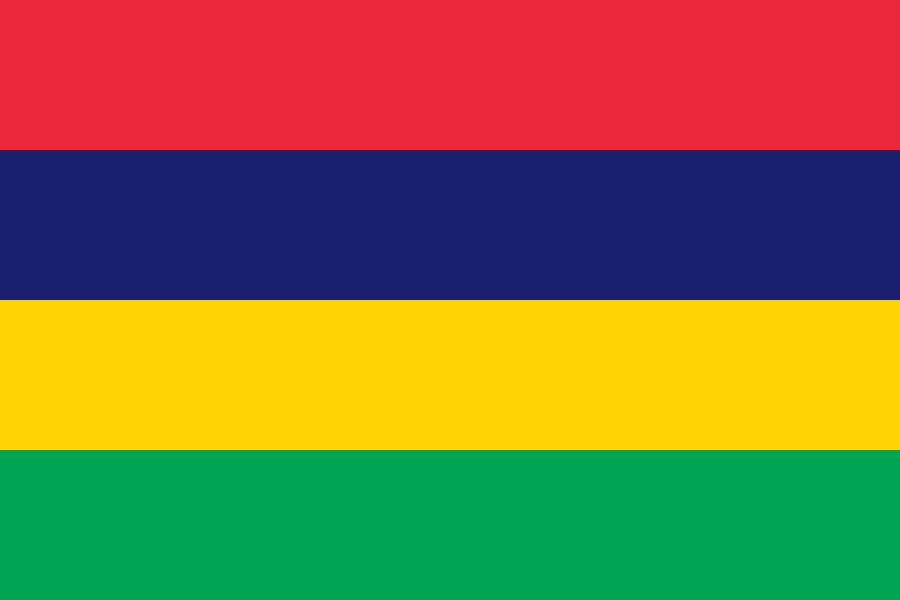
Mauritius, formally the Republic of Mauritius, is an Indian Ocean island republic located approximately 2,000 kilometers (1,200 miles) southeast of the African continent, east of Madagascar. It consists of the main island (commonly known as Mauritius), Rodrigues, Agaléga, and St. Brandon. The Mascarene Islands include the islands of Mauritius and Rodrigues, as well as adjacent Réunion (a French overseas department). Port Louis, Mauritius' capital and biggest city, is where the majority of the population lives. The nation covers 2,040 square kilometers (790 square miles) and has a 2.3 million square kilometer exclusive economic zone.
Around 975, Arab sailors were the first to discover the desolate island, which they named Dina Arobi. The first verified discovery was made by Portuguese sailors in 1507, who otherwise showed little interest in the islands. The Dutch acquired ownership in 1598 and established a series of short-lived colonies over a 120-year span until abandoning their attempts in 1710. In 1715, France acquired sovereignty and renamed the island Isle de France. The island was taken by the United Kingdom in 1810, and four years later, France surrendered Mauritius and its dependencies to the United Kingdom in the Treaty of Paris (1814). Rodrigues, Agaléga, St. Brandon, Tromelin, the Chagos Archipelago, and, until 1906, the Seychelles were all part of the British colony of Mauritius. Because the Treaty of Paris did not directly name Tromelin, Mauritius and France disagree on its sovereignty. Until 1968, Mauritius was predominantly a plantation-based colony of the United Kingdom. Approximately two-thirds of the population (Indo-Mauritians) and slightly more than a quarter (Africans) are of Indian ancestry (Mauritian Creoles).
Three years before Mauritius gained independence, the United Kingdom separated the Chagos Archipelago from Mauritian sovereignty, as well as the islands of Aldabra, Farquhar, and Desroches from the Seychelles, to establish the British Indian Ocean Territory (BIOT). The native people was evicted, and the main island, Diego Garcia, was leased to the US. The UK has limited access to the Chagos Archipelago, banning casual visitors, the media, and previous residents from entering. The sovereignty of the Chagos Islands is contested between Mauritius and the United Kingdom. The International Court of Justice issued an advisory opinion in February 2019 directing the UK to restore the Chagos Islands to Mauritius as soon as possible in order to complete Mauritius' decolonization.
Mauritius' population are ethnically, culturally, linguistically, and religiously varied due to its geographic position and centuries of colonization. It is Africa's only nation where Hinduism is the most widely practiced religion. The island's government is based on the Westminster parliamentary system, and Mauritius is rated highly for economic and political freedom, as well as being the only African nation with complete democracy. Mauritius is also the only nation on the continent with a "very high" Human Development Index. The nation is rated as a high-income economy by the World Bank. Mauritius is also regarded as the most competitive and sophisticated economy in the African area. The nation is a welfare state. For students, older persons, and the handicapped, the government offers free universal healthcare, free education up to the tertiary level, and free public transportation. The Global Peace Index named Mauritius the most peaceful African nation in 2019.
Mauritius, like the other Mascarene Islands, is recognized for its diverse flora and wildlife. Many of the island's species are unique. The island was the sole known habitat of the dodo, which, along with numerous other bird species, was wiped off by human activity not long after the island was settled.