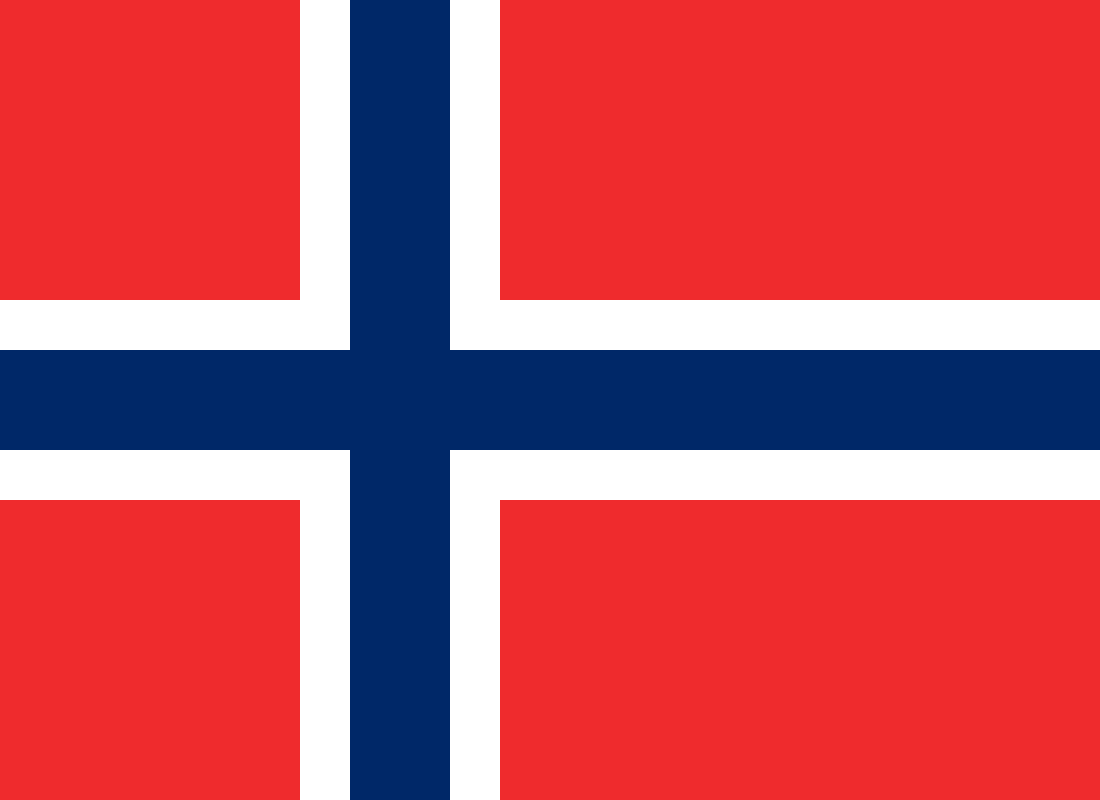
Norway, formally the Kingdom of Norway, is a Nordic nation in Northern Europe, occupying the western and northernmost parts of the Scandinavian Peninsula. Norway also includes the isolated Arctic island of Jan Mayen and the Svalbard archipelago. Bouvet Island, in the Subantarctic, is a Norwegian dependency; it also claims the Antarctic territories of Peter I Island and Queen Maud Land. Oslo is Norway's capital and biggest city.
Norway has a total area of 385,207 square kilometers (148,729 square miles) with a population of 5,425,270 people as of January 20, 2022. The nation has a 1,619-kilometer-long eastern border with Sweden (1,006 mi). It is bounded to the northeast by Finland and Russia, and to the south by the Skagerrak strait, which is shared by Denmark and the United Kingdom. Norway has a long coastline that borders the North Atlantic Ocean and the Barents Sea. Norway's climate is dominated by the marine influence, with warm lowland temperatures on the seashores; the interior, although colder, is also much milder than locations elsewhere in the globe at such northerly latitudes. Temperatures over freezing are frequent on the seashore even during polar night in the north. The oceanic impact causes heavy rain and snowfall in several parts of the nation.
The current King of Norway is Harald V of the House of Glücksburg. Since 2021, Jonas Gahr Store has been Prime Minister, succeeding Erna Solberg. Norway, being a unitary sovereign state with a constitutional monarchy, shares state authority among the parliament, cabinet, and supreme court, as established by the 1814 constitution. The kingdom was founded in 872 as a union of many small kingdoms and has been in continuous existence for 1,150 years. Norway was a member of the Kingdom of Denmark–Norway from 1537 to 1814, and it was in a personal union with the Kingdom of Sweden from 1814 to 1905. Norway was neutral throughout WWI and remained so until April 1940, when it was invaded and controlled by Nazi Germany until the conclusion of WWII.
Norway is divided into two administrative and political levels: counties and municipalities. Through the Sámi Parliament and the Finnmark Act, the Sámi people enjoy some self-determination and authority over the traditional territory. Norway has strong links with both the European Union and the United States. Norway is also a founding member of the United Nations, NATO, the European Free Trade Association, the Council of Europe, the Antarctic Treaty, and the Nordic Council; a member of the European Economic Area, the World Trade Organization, and the Organization for Economic Cooperation and Development; and a member of the Schengen Area. Furthermore, the Norwegian languages are mutually intelligible with Danish and Swedish.
Norway adheres to the Nordic welfare model, which includes universal health care and a robust social security system, and its principles are based on egalitarian ideals. The Norwegian government owns a major portion of important industrial sectors and has vast deposits of petroleum, natural gas, minerals, timber, seafood, and freshwater. The petroleum sector contributes around a quarter of the country's GDP (GDP). Norway is the world's greatest producer of oil and natural gas per capita outside of the Middle East.
According to the World Bank and IMF, the nation has the fourth-highest per-capita GDP in the world. Norway is ranked eleventh on the CIA's GDP (PPP) per capita list (2015 estimate), which includes autonomous territories and regions. It boasts the world's biggest sovereign wealth fund, at $1 trillion USD. Norway has achieved the world's top Human Development Index score since 2009, a position it also held between 2001 and 2006; it also has the greatest inequality-adjusted ranking as of 2018. Norway rated top in the World Happiness Report in 2017 and continues to lead the OECD Better Life Index, Index of Public Integrity, Freedom Index, and Democracy Index. Norway also boasts one of the world's lowest crime rates.
Although ethnic Norwegians constitute the majority of the Norwegian population, immigration has accounted for more than half of population growth in the twenty-first century; in 2021, the five largest minority groups in the country were the descendants of Polish, Lithuanian, Somali, Pakistani, and Swedish immigrants.