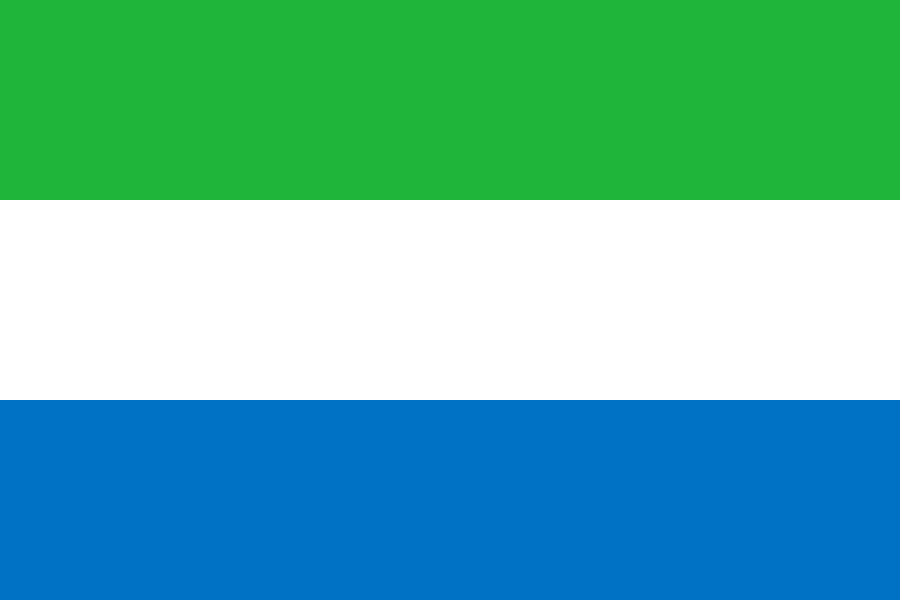
Sierra Leone, officially the Republic of Sierra Leone, and colloquially Salone, is a West African republic on the southwest coast. It is bounded to the southeast by Liberia, while the northern part of the country is surrounded by Guinea. Sierra Leone has a tropical climate, a diversified ecosystem ranging from savanna to rainforests, an area of 71,740 km2 (27,699 sq mi), and a population of 7,092,113 people according to the 2015 census. Freetown is the capital and biggest city. The nation is organized into five administrative regions, each of which has 16 districts. Sierra Leone is a constitutional republic with a unicameral legislature and a directly elected president who serves a five-year term with a two-term limit. Julius Maada Bio is the current president. Sierra Leone is a secular country with a constitution that guarantees the separation of state and religion as well as religious freedom (which includes freedom of thoughts and religion). Muslims constitute almost three-quarters of the population, with a strong Christian minority. Religious tolerance is highly strong in the West African country, and it is widely accepted as a standard and part of Sierra Leone's cultural character.
Although the country and its borders have been inhabited for millennia, Sierra Leone, as the country and its borders are known today, was founded by the British Crown in two phases: first, the coastal Sierra Leone Colony in 1808 (for returning Africans following the abolition of slavery); and second, the inland Protectorate in 1896. (as the Crown needed to establish more dominion inland following the outcome of the Berlin Conference of 1884-1885). As a result, the nation was renamed the Sierra Leone Colony and Protectorate, or simply British Sierra Leone. Sierra Leone obtained independence from the United Kingdom on April 27, 1961, and on the same day became a Commonwealth dominion; the country's name was changed to the Dominion of Sierra Leone. Sir Milton Margai was the first Prime Minister of Sierra Leone.
Sierra Leone had an upsurge in political activity, changes, turbulence, humanitarian and socioeconomic problems in the decades after independence. On May 27, 1961, the republic held its first general elections as an independent nation. Margai was re-elected Prime Minister after his Sierra Leone People's Party (SLPP) gained a majority of legislative seats. A new constitution was enacted in 1971, clearing the way for Sierra Leone to become a republic and Siaka Stevens, head of the All People's Congress (APC), to become the country's first executive president. Stevens held this office for 14 years (until 1985) in a one-party government made possible by the contentious 1978 Constitution. However, Stevens' hand-picked successor, Joseph Saidu Momoh, vowed to restore the nation to a multi-party system; in 1991, a new constitution was established that gave the basis for a multi-party democracy. The same year, a horrific civil war broke out, lasting 11 years and destroying practically everything that distinguished Sierra Leone as a country. President Momoh was deposed in a coup headed by Sierra Leone Army commander Valentine Strasser barely a year after the conflict began (in 1992). Strasser was eventually "outed" by his army colleague and second-in-command Julius Maada Bio for failing to commit to a speedy transition to a civilian administration. Bio would then use a general election to revert the nation to a democratic republic in 1996.
Despite the country's harsh civil conflict, the idea of a return to multi-party democracy sparked new hopes and enormous expectations among the majority of Sierra Leoneans in early 1996, as the national debate "Peace before Elections versus Elections before Peace" became a hot subject. The discussion was eventually won by "Elections before Peace." Ahmad Tejan Kabbah won the 1996 presidential election, becoming Sierra Leone's first multi-party democratically elected president. Since then, elections have ensured a seamless transfer to the office. Kabbah fled to Guinea after a short coup conducted by Sierra Leone Army Major Johnny Paul Koroma in 1997. He was reinstated after nine months thanks to ECOMOG's military involvement. Kabbah's presidency marked the beginning of a new Sierra Leone, with the civil war ending in 2002, a focus on fostering national unity and reconciliation, trust in government, peace and stability, improved relations with many countries, and the refounding of the Sierra Leone Armed Forces with special assistance and training led by the Government of the United Kingdom.
Sierra Leone is home to around 18 ethnic groups, the two biggest and most powerful of which are the Temne and Mende peoples. Creole people, descendants of liberated African American and West Indian slaves, make up around 2% of the country's population. In schools and government administration, English is the official language. Krio is the most frequently spoken language in Sierra Leone, with 97 percent of the people speaking it. Sierra Leone is endowed with natural resources, including diamonds, gold, bauxite, and aluminum. The country is a member of the United Nations, the African Union, the Economic Community of West African States (ECOWAS), the Mano River Union, the Commonwealth of Nations, the International Monetary Fund, the World Bank, the World Trade Organization, the African Development Bank, and the Organization of Islamic Cooperation. Fourah Bay College is the first Western-style university in Sub-Saharan Africa (established in 1827).