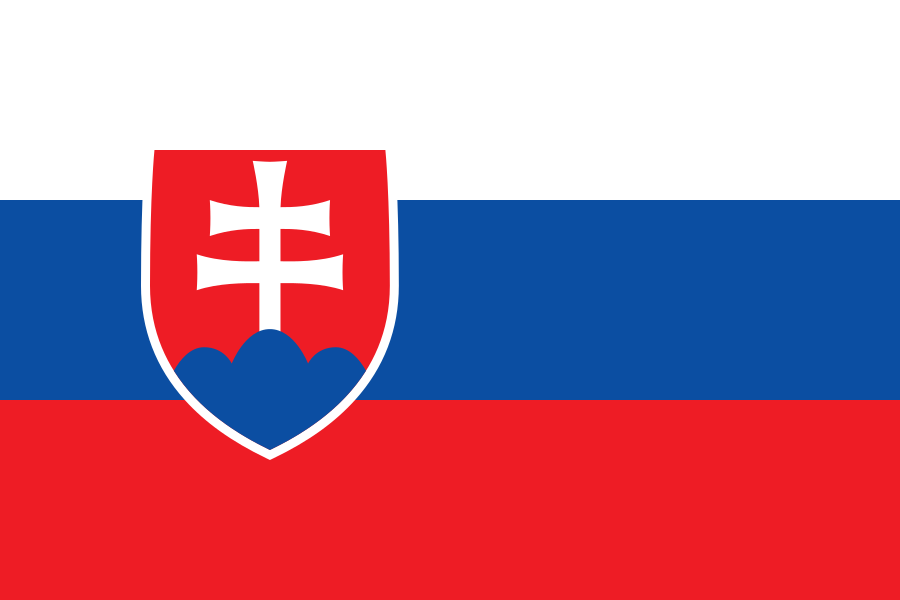
Slovakia, formally the Slovak Republic, is a landlocked Central European nation. It is bounded to the north by Poland, to the east by Ukraine, to the south by Hungary, to the southwest by Austria, and to the northwest by the Czech Republic. Slovakia's primarily hilly geography covers over 49,000 square kilometers (19,000 square miles) and has a population of over 5.4 million people. Bratislava is the capital and biggest city, while Koice is the second largest.
The Slavs arrived in what is now Slovakia in the fifth and sixth century. They were instrumental in the establishment of Samo's Empire in the seventh century. They founded the Principality of Nitra in the ninth century, which was eventually captured by the Principality of Moravia to become Great Moravia. After the disintegration of Great Moravia in the tenth century, the land was included by the Principality of Hungary, which would later become the Kingdom of Hungary in 1000. Following the Mongol invasion of Europe in 1241 and 1242, most of the area was devastated. The land was fully recovered owing to Béla IV of Hungary, who also settled Germans, who became a significant ethnic minority in the area, particularly in what is now central and eastern Slovakia.
Czechoslovakia was created after World War I and the disintegration of the Austro-Hungarian Empire. During the interwar era, it was the only nation in Central and Eastern Europe that remained a democracy. Nonetheless, local fascist groups progressively gained control in Slovak regions, and the first Slovak Republic functioned as a partly recognized client state of Nazi Germany throughout World War II. Czechoslovakia was re-established as an independent nation after the conclusion of World War II. Following a coup in 1948, Czechoslovakia fell under communist control and became a member of the Soviet-led Eastern Bloc. Attempts in Czechoslovakia to liberalize communism culminated in the Prague Spring, which was defeated by the Warsaw Pact invasion of Czechoslovakia in August 1968. The Velvet Revolution peacefully abolished Communist government in Czechoslovakia in 1989. Slovakia gained independence on January 1, 1993, after the peaceful disintegration of Czechoslovakia, sometimes known as the Velvet Divorce.
Slovakia is a developed nation with a high-income advanced economy that ranks extremely high on the Human Development Index. It also ranks well in terms of civil rights, journalistic freedom, internet freedom, democratic government, and peace. The country balances a market economy with a robust social security system, providing individuals with universal health care, free education, and one of the OECD's longest paid parental leaves. Slovakia is a member of the European Union, the Eurozone, the Schengen Area, NATO, CERN, the OECD, the World Trade Organization, the Council of Europe, the Visegrád Group, and the OSCE. In addition, Slovakia has eight UNESCO World Heritage Sites. Slovakia, the world's greatest per capita auto manufacturer, produced 1.1 million cars in 2019, accounting for 43 percent of total industrial production.