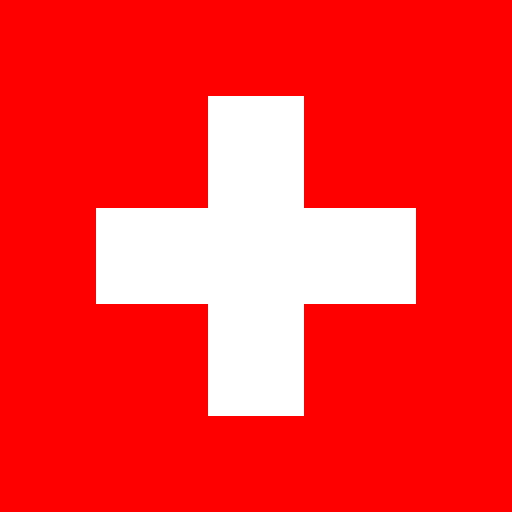
Switzerland, formally known as the Swiss Confederation, is a landlocked nation in Western, Central, and Southern Europe. The nation is a federal republic made up of 26 cantons, with the central government centered in Bern. Switzerland is bounded to the south by Italy, to the west by France, to the north by Germany, and to the east by Austria and Liechtenstein. It is physically separated into the Swiss Plateau, the Alps, and the Jura, and has a total area of 41,285 km2 (15,940 sq mi) and 39,997 km2 of land (15,443 sq mi). Although the Alps cover the majority of the country, the Swiss population of around 8.5 million is centered largely on the plateau, which is home to the country's greatest cities and economic centers, including Zürich, Geneva, and Basel. Several international organizations have offices in these three cities, including the World Trade Organization, the World Health Organization, the International Labour Organization, FIFA's headquarters, the United Nations' second-largest office, and the Bank for International Settlements. These cities also house Switzerland's major international airports.
The Old Swiss Confederacy was formed in the late Middle Ages as a consequence of military victories against Austria and Burgundy. In 1648, the Peace of Westphalia legally recognized Swiss independence from the Holy Roman Empire. The Federal Charter of 1291 is regarded as Switzerland's foundation constitution, and it is commemorated on Swiss National Day. Switzerland has maintained a solid policy of military neutrality since the 16th century Reformation; it has not fought an international war since 1815 and did not join the United Nations until 2002. Nonetheless, it maintains an active foreign policy. It is regularly engaged in global peace-building activities. The Red Cross, one of the world's oldest and most well-known humanitarian organizations, was founded in Switzerland. Although it is a founding member of the European Free Trade Association, it is not a member of the European Union, the European Economic Area, or the Eurozone. It does, however, participate in the Schengen Area and the European Union via bilateral accords.
Switzerland is situated at the crossroads of Germanic and Romance Europe, as shown by its four major language and cultural regions: German, French, Italian, and Romansh. Despite the fact that the majority of the population speaks German, Swiss national identity is built on a shared historical past, shared principles such as federalism and direct democracy, and Alpine symbols.
Switzerland is known by a number of local names due to its linguistic diversity: Schweiz [ˈʃvaɪts] (German); Suisse [sɥis(ə)] (French); Svizzera [ˈzvittsera] (Italian); and Svizra [ˈʒviːtsrɐ, ˈʒviːtsʁɐ] (Romansh). On coins and stamps, the Latin term, Confoederatio Helvetica – often abbreviated to "Helvetia" - replaces the four national languages. It is a developed nation with the greatest nominal wealth per adult and the eighth-highest per capita GDP. Some international measurements, such as economic competitiveness and human development, place it highly. Its cities, such as Zürich, Geneva, and Basel, rank among the greatest in the world in terms of quality of life, while having some of the world's highest living expenses. IMD ranked Switzerland tops in recruiting talented employees in 2020. According to the World Economic Forum, it is the fifth most competitive nation in the world.