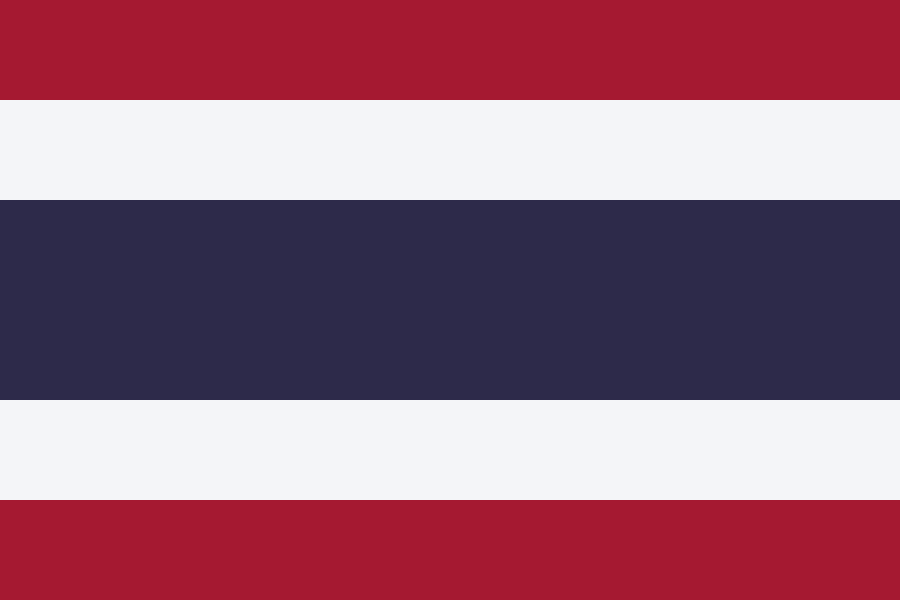
Thailand, once known as Siam, and officially the Kingdom of Thailand, is a Southeast Asian nation with a geographical area of 513,120 square kilometers (198,120 square miles) with a population of almost 70 million people. It shares borders with Myanmar and Laos to the north, Laos and Cambodia to the east, the Gulf of Thailand and Malaysia to the south, and the Andaman Sea and Myanmar to the west. Thailand's marine boundaries include Vietnam to the southeast and Indonesia and India to the southwest. Thailand has been subjected to a number of coups and military dictatorships. Thailand has been a nominally parliamentary constitutional monarchy since 2019. However, structural advantages in the constitution have secured the military's grasp on power in reality. Bangkok is the capital and biggest city in Thailand.
From the 11th century, Tai peoples moved from southern China to mainland Southeast Asia. The area was dominated by Indianised kingdoms such as the Mon, Khmer Empire, and Malay nations, who competed with Thai states such as the Kingdoms of Ngoenyang, Sukhothai, Lan Na, and Ayutthaya. A Portuguese diplomatic expedition to Ayutthaya, which established a regional power by the end of the 15th century, initiated European interaction in 1511. Ayutthaya reached its zenith under the reign of the cosmopolitan Narai, then progressively declined until it was destroyed in the Burmese–Siamese War. Taksin rapidly reunified the region and formed the brief-lived Thonburi Kingdom. In 1782, Buddha Yodfa Chulaloke, the first ruler of the present Chakri dynasty, succeeded him.
Throughout the period of Western imperialism in Asia, Siam was the only country in the area to resist colonization by foreign powers, despite being compelled to surrender land, economic, and legal concessions in unequal treaties. During Chulalongkorn's reign, the Siamese government was centralized and turned into a modern unitary absolute monarchy. Siam allied with the Allies in World War I, a political choice intended to repair the unequal treaties. Following a bloodless revolution in 1932, it became a constitutional monarchy and changed its name to Thailand, which was a Japanese ally throughout World War II. A military revolution led by Field Marshal Sarit Thanarat in the late 1950s resurrected the monarchy's traditionally significant role in politics. Thailand became a key US ally and played an anti-communist role in the area as a member of the unsuccessful SEATO, but has worked to repair ties with Communist China and Thailand's neighbors since 1975.
Thailand has cycled between democracy and military control on a regular basis, with the exception of a short period of parliamentary democracy in the mid-1970s. Thailand has been embroiled in a series of bitter political conflicts since the 2000s, culminating in two coups (in 2006 and 2014), the establishment of its current constitution, and a nominally democratic government following the 2019 Thai general election, and ongoing pro-democracy protests that began in 2020.
Thailand is a global middle power and a founding member of ASEAN, and it scores high on the Human Development Index. It has the second-largest economy in Southeast Asia and the 22nd-largest in the world in terms of purchasing power parity. Thailand is characterized as a recently industrialized economy, with manufacturing, agriculture, and tourism as the most important industries.