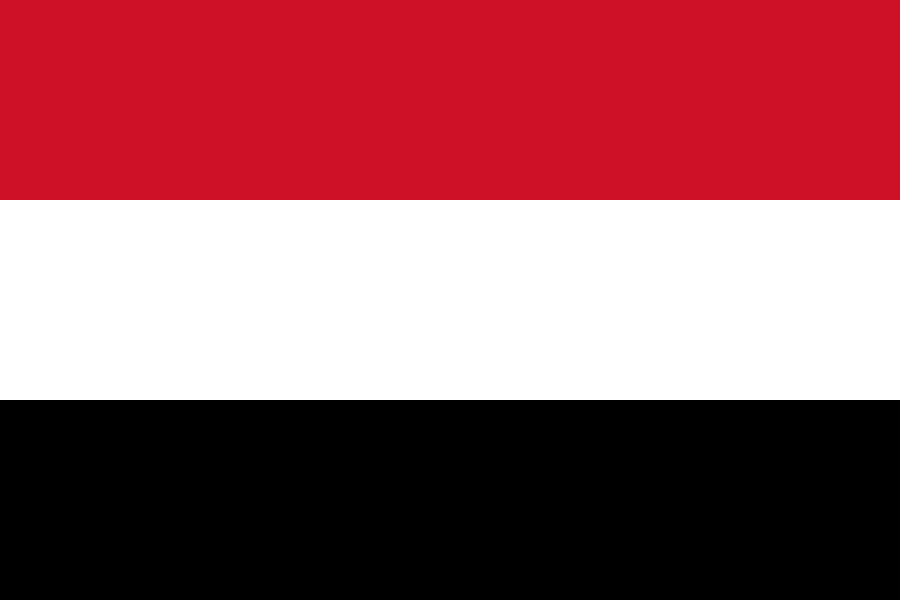
Yemen, formally the Republic of Yemen, is a nation in Western Asia on the Arabian Peninsula's southern tip. It has maritime boundaries with Eritrea, Djibouti, and Somalia, as well as Saudi Arabia to the north and Oman to the northeast. It is the peninsula's second-largest Arab sovereign state, covering 555,000 square kilometers (214,000 square miles). The shoreline runs for almost 2,000 kilometers (1,200 miles). Sanaa is Yemen's legally declared capital and biggest city. The country's population is expected to reach 30,491,000 by 2021.
Yemen was formerly the home of the Sabaeans, a historic trade kingdom that comprised portions of modern-day Ethiopia and Eritrea. Later, about 275 CE, Judaism affected the Himyarite Kingdom. The fourth century saw the arrival of Christianity. In the seventh century, Islam expanded fast, and Yemenite armies were vital in the early Islamic victories. Several dynasties arose from the 9th through 16th century, including the Rasulid dynasty. In the 1800s, the nation was split between the Ottoman and British empires. Yemen's Zaydi Mutawakkilite Kingdom was created after World War I, prior to the establishment of the Yemen Arab Republic in 1962. South Yemen was a British protectorate known as the Aden Protectorate until 1967, when it gained independence and eventually became a Marxist-Leninist state. In 1990, the two Yemeni republics merged to establish the present Republic of Yemen (al-Jumhryah al-Yamanyah). President Ali Abdullah Saleh served as the nascent republic's first president until his resignation in 2012, after the Arab Spring.
Yemen has been in a political crisis since 2011, beginning with public demonstrations over poverty, unemployment, and corruption, as well as President Saleh's proposal to rewrite Yemen's constitution and erase the presidential term limit. President Saleh resigned, and the presidency was handed over to Abdrabbuh Mansur Hadi. Since then, Yemen has been embroiled in a civil war (along with a Saudi-led military intervention aimed at restoring Hadi's government), with several proto-state entities claiming to govern the country: the Cabinet of Yemen/Presidential Leadership Council, the Supreme Political Council, and the Southern Transitional Council. Since January 2016, at least 56,000 civilians and combatants have been murdered in Yemen as a result of armed conflict. The conflict has caused a famine that has affected 17 million people. The lack of clean drinking water, caused by depleted aquifers and the devastation of the country's water infrastructure, has also resulted in the greatest and fastest-spreading cholera epidemic in modern history, with 994,751 probable cases. Since the epidemic started spreading fast at the end of April 2017, over 2,226 individuals have perished. The continuous humanitarian crisis and fighting have drawn global condemnation for having a severe increasing impact on Yemen's humanitarian condition, which some claim has reached the level of a "humanitarian catastrophe," and others have even labeled it genocide. It has exacerbated the country's already precarious human rights status.
Yemen is an Arab League, United Nations, Non-Aligned Movement, and Organization of Islamic Cooperation member. It is classified as a least developed nation due to its multiple "severe structural barriers to sustainable development." According to the United Nations, Yemen has the most people in need of humanitarian help, with around 24 million people, or 85 percent of its population, in need. As of 2020, the nation ranks first in the Fragile State Index, second in the Global Hunger Index (surpassed only by the Central African Republic), and has the lowest Human Development Index of any non-African country.